
Vegetarian Food Morocco: Complete Guide to Plant-Based Eating in 2026
Morocco is, on the surface, a meat-heavy country. Lamb tagines, kefta skewers, mechoui roasted over coals, pastilla filled with pigeon — the most celebrated dishes of Moroccan cuisine are built around meat. So what does this mean for vegetarian and vegan travelers?
The good news is better than you might expect. Vegetarian food Morocco has to offer is genuinely excellent — a rich tradition of vegetable-based dishes, legumes, spiced salads, and flatbreads that can sustain a plant-based traveler through weeks of eating without ever feeling deprived. The challenge is knowing what to look for, what to avoid, and how to communicate your needs in a country where vegetarianism is not yet widely understood.
This guide covers everything vegetarian and vegan travelers need to know about eating in Morocco — from the best naturally plant-based dishes to the hidden animal ingredients that catch people off guard, and the restaurants across Morocco’s major cities that cater specifically to plant-based diets.
Is Morocco Vegetarian-Friendly?
The honest answer is: mostly yes, with some important caveats. Vegetarian food Morocco offers is abundant and delicious, but the concept of vegetarianism is not deeply embedded in Moroccan food culture. When you ask if a dish is vegetarian, the response “there’s no meat” sometimes means “there’s no large pieces of visible meat” — which is different from “this dish contains no animal products whatsoever.”
Chicken broth is used as a base in many seemingly vegetarian dishes, including some vegetable tagines and couscous preparations. Smen (a fermented, aged butter similar to ghee) is used in many traditional Moroccan recipes. And the concept of a dish being “vegan” — free of all animal products including eggs, dairy, and honey — is understood by fewer people still.
This is not a reason to avoid Morocco. It is simply a reason to learn the right vocabulary, ask the right questions, and know which dishes are reliably safe.
Naturally Vegetarian Moroccan Dishes
Morocco has a remarkable range of dishes that are naturally vegetarian or easily made vegetarian. These are the foundation of vegetarian food Morocco has to offer.
Zaalouk
Zaalouk is a cooked salad of roasted eggplant and tomatoes, seasoned with cumin, paprika, garlic, olive oil, and fresh cilantro and parsley. It is one of the most beloved dishes in Moroccan cuisine and is almost always vegan. Served at room temperature as a starter or side dish, zaalouk is eaten with fresh bread and is deeply, addictively good.
Taktouka
Taktouka is a cooked salad of roasted green peppers and tomatoes, similar in concept to zaalouk but with a lighter, more herbal flavor. Like zaalouk, taktouka is typically vegan and is served as part of the spread of salads that opens a traditional Moroccan meal.
Harira (sometimes)
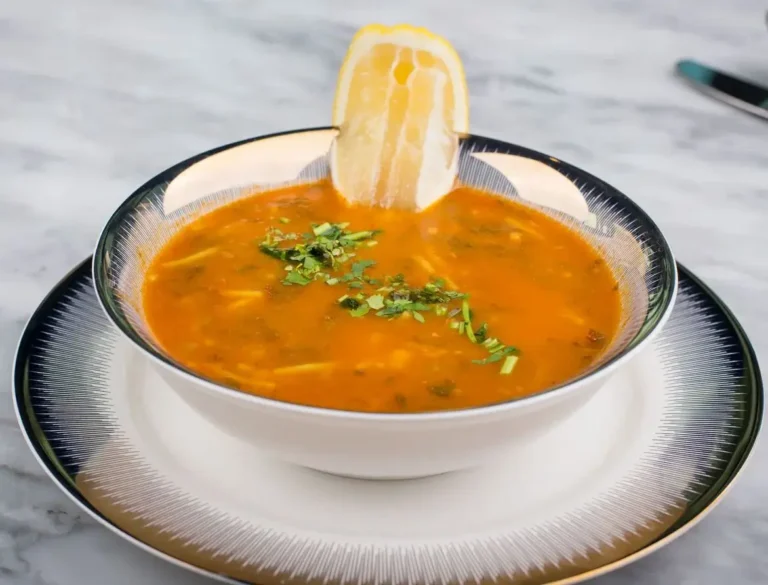
Harira, the rich tomato, lentil, and chickpea soup that is Morocco’s most beloved comfort food, can be either vegetarian or not depending on how it is prepared. Traditional harira contains lamb or beef, but many restaurants and home cooks make a fully vegetarian version that is indistinguishable in flavor from the meat-containing original. Always ask — “Harira bla lham?” (harira without meat?) will usually get a clear answer.
Vegetable Tagine
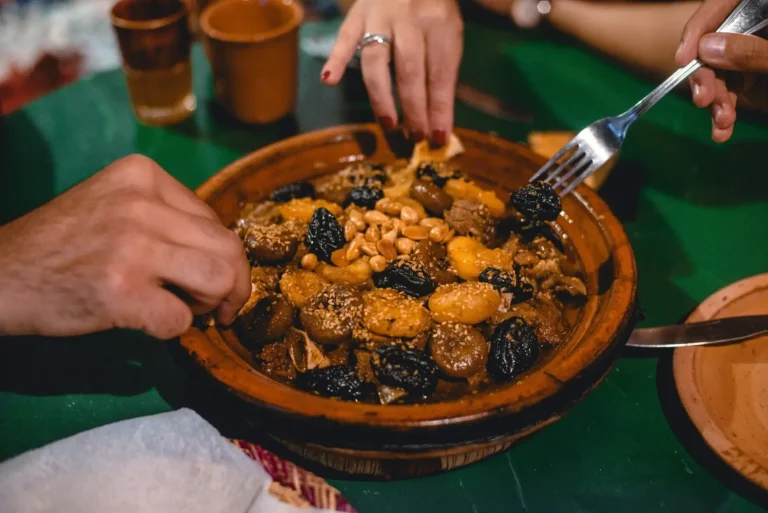
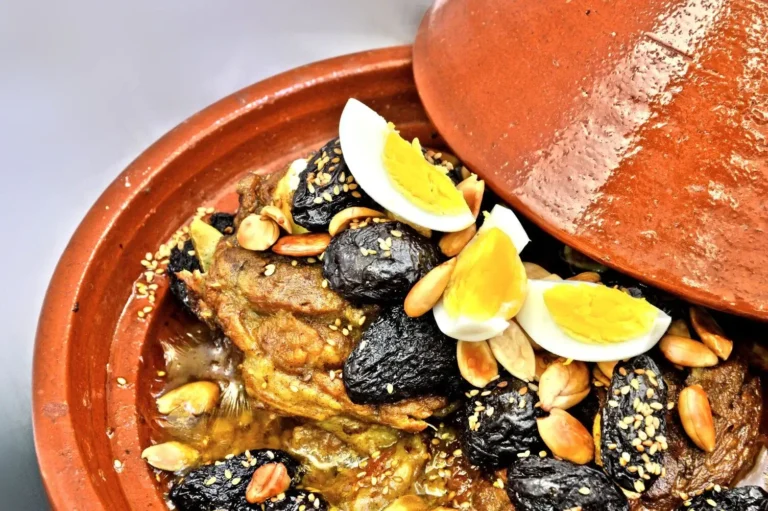
Vegetable tagines are widely available across Morocco and represent some of the finest vegetarian food Morocco has to offer. A well-made vegetable tagine — typically featuring a combination of carrots, potatoes, turnips, courgettes, and chickpeas, slow-cooked with saffron, ginger, cumin, and preserved lemon — is a genuinely spectacular dish. The caveat, as noted above, is that some vegetable tagines are made with chicken or vegetable stock rather than water. Ask explicitly: “Tagine dial khodra bla lham, bla djaj?” (vegetable tagine without meat, without chicken?)
Bissara
Bissara is a thick soup or dip made from dried fava beans, seasoned generously with cumin, paprika, and olive oil, and served with fresh bread. It is a staple of Moroccan street food culture, particularly in the north of the country, and is almost always vegan. A bowl of bissara costs 5–15 MAD from street stalls and is one of the most filling and satisfying cheap eats in Morocco.
Moroccan Salads
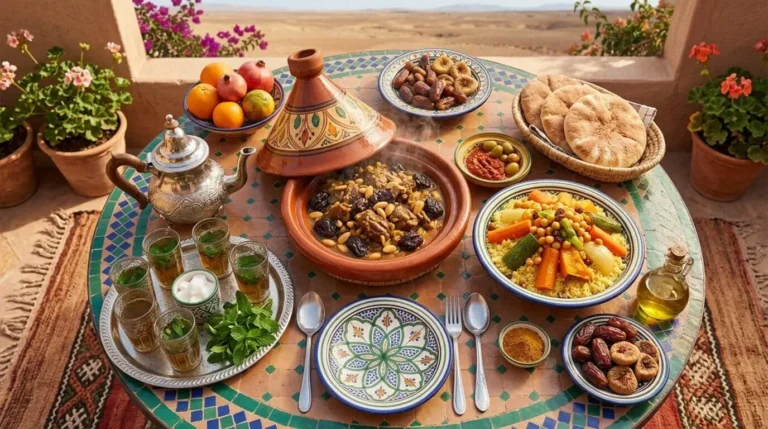
A traditional Moroccan meal begins with a spread of cooked salads — zaalouk, taktouka, carrot salad with cumin and orange blossom water, beet salad with harissa, potato salad with preserved lemon and herbs. This spread is one of the greatest expressions of vegetarian food Morocco offers, and in many restaurants you can make an entire satisfying meal from the salad course alone.
Msemen and Meloui
These Moroccan flatbreads — msemen (square and layered) and meloui (round and coiled) — are typically vegan and are one of the great pleasures of Moroccan street food. Eaten for breakfast or as a snack with argan oil and honey (note: not vegan) or olive oil and zaalouk (vegan), they are available from street stalls throughout Morocco for 2–5 MAD each.
Couscous with Seven Vegetables
The vegetarian version of Morocco’s national Friday dish is one of the finest expressions of vegetarian food Morocco has produced. Steamed semolina topped with a mountain of slow-cooked vegetables — carrots, turnips, courgettes, cabbage, chickpeas, and more — dressed with a fragrant vegetable broth, it is a dish of extraordinary depth and comfort. Again, confirm that it has been made with vegetable rather than meat broth.
What Vegetarians and Vegans Need to Watch Out For
Hidden Meat Stock
The most common issue for vegetarians eating in Morocco is the use of meat or chicken stock in dishes that appear vegetarian. Always ask: “Fiha marga dial lham?” (Does it contain meat stock?) This one question, asked consistently, will save you from most surprises.
Smen in Couscous
Smen, the fermented Moroccan butter, is traditionally added to couscous during steaming to give it flavor and richness. Vegans should ask specifically whether smen has been used: “Fiha smen?” If so, ask if it can be made without.
Honey in Pastries
Moroccan pastries are extraordinary, but many are drenched in honey. Vegans should check specifically whether pastries contain honey before eating.
Eggs in Kefta Tagine
Kefta tagine (spiced meatballs in tomato sauce with eggs) is obviously not vegetarian, but the tomato sauce base is sometimes used in vegetarian dishes as well. Always confirm ingredients.
How to Communicate Your Dietary Needs in Morocco
Learning a few key phrases dramatically improves the experience of finding vegetarian food Morocco wide:
- “Ana nabati” — I am vegetarian (Arabic)
- “Mabghitsh lham” — I don’t want meat
- “Bla lham, bla djaj, bla hout” — Without meat, without chicken, without fish
- “Fiha lham?” — Does it contain meat?
- “Fiha marga dial lham?” — Does it contain meat stock?
- “Bla smen” — Without smen (for vegans)
Writing these phrases on a piece of paper or keeping them on your phone to show restaurant staff is highly effective, particularly in smaller establishments where English is limited.
The Best Cities for Vegetarian Food in Morocco
Marrakech
Marrakech has the most developed vegetarian food Morocco scene of any city in the country, driven by the high volume of international tourists and a growing awareness of plant-based diets. Several restaurants in and around the medina now offer explicitly vegetarian and vegan menus.
Earth Café in the medina is one of Morocco’s most celebrated vegetarian restaurants, serving creative plant-based versions of traditional Moroccan dishes as well as international options. Expect to pay 80–150 MAD for a main course.
The rooftop restaurant at Café des Épices in the spice market area offers excellent vegetable tagines and salads in a beautiful setting.
Fes
Fes is more traditional than Marrakech and has fewer explicitly vegetarian restaurants, but the range of naturally vegetarian dishes available in the medina is excellent. The covered food market near Bab Bou Jeloud is an excellent place to find fresh bissara, vegetable tagines, and Moroccan salads at very reasonable prices.
Chefchaouen
Chefchaouen blue city has a relaxed, slightly bohemian atmosphere that makes it one of the friendliest cities in Morocco for vegetarian travelers. Several cafés and restaurants in the medina offer good vegetarian options, and the local cuisine’s emphasis on mountain vegetables and goat dairy products rather than heavy meat dishes makes it naturally compatible with plant-based eating.
Essaouira
Essaouira’s Atlantic coastal location means the local cuisine focuses heavily on fresh fish and seafood — not ideal for vegans, but excellent for vegetarians who eat fish. The city has several good vegetarian-friendly restaurants catering to the bohemian traveler crowd it attracts.
A Sample Day of Vegetarian Eating in Morocco
To show just how abundant vegetarian food Morocco offers can be, here is what a full day of plant-based eating might look like:
Breakfast: Msemen or meloui with olive oil and zaalouk from a street stall (15–20 MAD), fresh-squeezed orange juice (4 MAD), mint tea (10 MAD).
Lunch: A spread of Moroccan salads — zaalouk, taktouka, carrot salad, beet salad — with fresh bread, followed by a vegetable tagine with chickpeas and preserved lemon (70–100 MAD total).
Afternoon snack: A bowl of bissara with bread and olive oil from a street stall (10–15 MAD).
Dinner: Vegetarian harira soup to start, followed by vegetarian couscous with seven vegetables (80–120 MAD total).
Total cost for a full day of excellent vegetarian eating in Morocco: approximately 180–260 MAD (less than $20 USD). Vegetarian food Morocco offers is not only delicious — it is extraordinarily good value.
Final Thoughts
Morocco is a country that rewards curious, flexible eaters, and vegetarian and vegan travelers who arrive prepared will find a food culture that is both welcoming and deeply satisfying. The key is knowledge: knowing which dishes are naturally plant-based, knowing what to ask, and knowing where to eat.
The vegetarian food Morocco has been quietly perfecting for centuries — in the zaalouk, the bissara, the vegetable tagine, the mountain of salads that opens every traditional meal — is some of the finest plant-based cooking in the world. Come hungry, come curious, and you will eat magnificently.
For more on Moroccan food culture, read our guide to traditional Moroccan dishes you must try and our complete guide to Moroccan hospitality and customs. For vegetarian restaurant recommendations, visit HappyCow Morocco.
One Comment