Moroccan Couscous Recipe: How to Make the Perfect Friday Couscous at Home
Couscous is Morocco’s national dish — a fact enshrined not just in culinary tradition but in the UNESCO Intangible Cultural Heritage list, where Moroccan couscous was inscribed in 2020 as a living tradition of extraordinary cultural significance. Every Friday, in homes across Morocco, families gather around a shared pot of steamed couscous with seven vegetables and slow-cooked meat — a ritual as deeply embedded in Moroccan culture as the Friday prayers that precede it.
Learning to make an authentic Moroccan couscous recipe at home is one of the most rewarding culinary projects available — more complex than a tagine, more demanding in technique, and more spectacular in result. This guide covers the complete traditional method, the shortcuts that work without sacrificing quality, and the three essential Moroccan couscous recipes every home cook should know.
Understanding Moroccan Couscous
Before the recipes, some essential context that will make every Moroccan couscous recipe you attempt significantly more successful.
What is Couscous?
Couscous is made from semolina wheat — the hard durum wheat that also produces pasta — rolled into tiny granules and coated with fine wheat flour. The traditional Moroccan couscous recipe uses hand-rolled couscous made by women who work the semolina with water and flour in a large flat dish (gsaa), rolling the granules by hand to the correct size and then drying them for storage. This hand-rolled couscous is available in Moroccan markets and specialty food shops and produces results significantly superior to the pre-cooked instant couscous sold in Western supermarkets.
For home cooks outside Morocco, medium-grain pre-cooked couscous is a perfectly acceptable substitute for everyday cooking, though the texture will be slightly different from the hand-rolled original.
The Couscousière
Traditional Moroccan couscous recipe preparation uses a couscousière — a two-part vessel consisting of a large pot (the base, in which the broth and stew cook) and a steamer basket (the top, in which the couscous is placed to steam over the boiling broth). The steam from the broth below cooks the couscous above, infusing it with flavor while keeping the grains separate and fluffy.
A couscousière is the ideal equipment for any Moroccan couscous recipe, but a standard pasta pot with a steamer insert, or a large pot with a colander sitting snugly on top and sealed with a clean kitchen towel, produces excellent results.
The Seven Vegetables
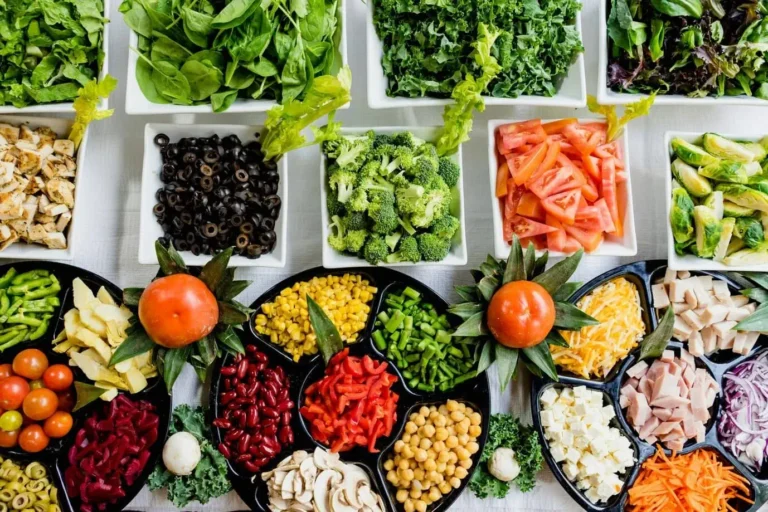
The traditional Moroccan couscous recipe with seven vegetables (couscous bidaoui or couscous tfaya) includes a specific combination of vegetables that varies by region and season but typically includes carrots, turnips, courgettes, cabbage, chickpeas, onions, and a seventh vegetable that might be pumpkin, sweet potato, or parsnip depending on the season. The number seven is considered auspicious in Moroccan culture and the seven vegetables are not negotiable in a traditional Moroccan couscous recipe — though the specific vegetables can vary within the traditional framework.
Recipe 1: Classic Lamb Couscous with Seven Vegetables
The definitive Moroccan couscous recipe — served every Friday in Moroccan homes and the dish that most Moroccan cooks consider the true test of culinary skill.
Serves: 6–8
Preparation time: 30 minutes
Cooking time: 2.5–3 hours (traditional method) or 45 minutes (quick method)
Ingredients
For the stew:
- 1kg bone-in lamb shoulder, cut into large pieces
- 4 tablespoons olive oil or smen (aged Moroccan butter)
- 2 large onions, finely chopped
- 4 cloves garlic, minced
- 1 teaspoon ground ginger
- 1 teaspoon ground turmeric
- 1 teaspoon ground cinnamon
- 1 teaspoon ground cumin
- ½ teaspoon black pepper
- Large pinch saffron dissolved in 3 tablespoons warm water
- 2 large tomatoes, grated (skin discarded)
- Large bunch fresh cilantro, tied together
- Large bunch fresh flat-leaf parsley, tied together
- 1.5 liters water
- Salt to taste
For the seven vegetables:
- 3 medium carrots, peeled and halved lengthways
- 2 medium turnips, peeled and quartered
- ¼ small cabbage, cut into large wedges
- 3 medium courgettes, halved lengthways
- 400g tin chickpeas, drained
- 200g pumpkin or butternut squash, cut into large chunks
- 2 medium onions, quartered
For the couscous:
- 500g medium couscous (pre-cooked)
- 3 tablespoons olive oil or butter
- 1 teaspoon salt
- Approximately 500ml warm water or broth
For serving:
- 2 tablespoons butter
- Harissa (for those who want heat)
- Additional broth in a small pitcher
Method — Traditional Steaming Technique
Step 1 — Brown the lamb: Heat olive oil in the bottom of the couscousière or large pot over medium-high heat. Season lamb with salt and sear in batches until well browned on all sides. Remove and set aside.
Step 2 — Build the broth: Reduce heat to medium. Add chopped onions to the same pot and cook for 8 minutes until soft. Add garlic, ginger, turmeric, cinnamon, cumin, and black pepper. Cook for 2 minutes, stirring. Add grated tomatoes and cook for 5 minutes until the tomato liquid has mostly evaporated.
Step 3 — Return lamb and add water: Return the lamb to the pot. Add saffron water and 1.5 liters of water. Add the tied bunches of cilantro and parsley. Bring to a boil, then reduce to a gentle simmer. Cover and cook for 45 minutes.
Step 4 — First couscous steaming: While the broth simmers, prepare the couscous for its first steaming. Place the dry couscous in a large bowl and sprinkle with the salt. Add 250ml of warm water gradually, rubbing the couscous between your palms to distribute the water evenly and break up any clumps. The couscous should feel slightly damp but not wet.
Transfer the couscous to the steamer basket of the couscousière. Place over the simmering broth, making sure the steam can only escape upward through the couscous rather than around the edges (seal with a damp kitchen towel if necessary). Steam uncovered for 20 minutes.
Step 5 — Add root vegetables: After 45 minutes of broth cooking, add the carrots, turnips, and quartered onions to the broth. Continue simmering.
Step 6 — Second couscous treatment: Remove the steamer, transfer couscous to the large bowl. Add another 150ml warm water and 2 tablespoons of olive oil or butter. Work through the couscous with your fingers, breaking up clumps and distributing the fat evenly. Return to the steamer and steam for another 20 minutes.
Step 7 — Add remaining vegetables: Add cabbage, chickpeas, and pumpkin to the broth. Continue simmering for 15 minutes.
Step 8 — Third couscous treatment: Repeat the couscous treatment — remove from steamer, add a final 100ml warm water and remaining butter, work through with fingers. Return to steamer for a final 20 minutes.
Step 9 — Final vegetables: Add courgettes to the broth in the last 10 minutes of cooking — they need the least time and should remain slightly firm.
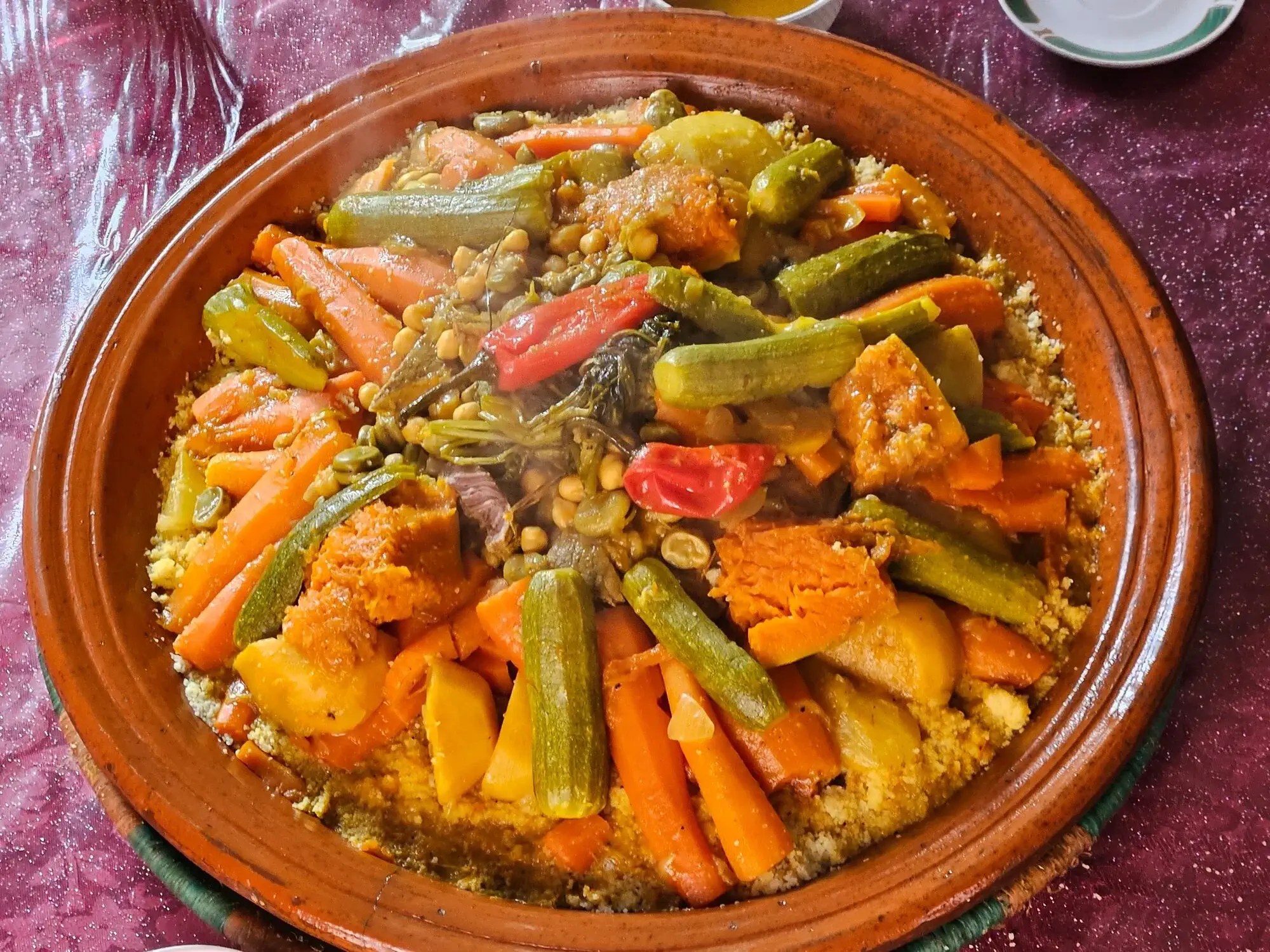
Step 10 — Assemble and serve: Transfer the couscous to a large, deep serving dish (tabsi). Mound it high in the center. Arrange the vegetables decoratively around and over the couscous. Place the lamb pieces on top. Ladle enough broth over the entire dish to moisten everything generously. Serve additional broth in a small pitcher at the table. Serve harissa separately for those who want heat.
Quick Method (45 minutes)
For weekday cooking, the traditional three-steaming method can be simplified:
Prepare the broth and vegetables as above. For the couscous, place in a bowl, pour 500ml of boiling broth or water over it, add 2 tablespoons of butter, cover with a plate and leave for 5 minutes. Fluff with a fork, working out all clumps. Steam over the broth for 10 minutes for best results, or simply serve after resting.
The quick method produces good couscous — slightly stickier and denser than the three-steaming version but entirely acceptable for everyday cooking.
Recipe 2: Vegetarian Couscous with Seven Vegetables
One of the finest Moroccan couscous recipes for vegetarian and vegan cooking — the seven vegetables, properly spiced and cooked in a rich vegetable broth, produce a dish of extraordinary depth and flavor.
Serves: 6
Preparation time: 20 minutes
Cooking time: 1 hour
Ingredients
For the broth and vegetables:
- 4 tablespoons olive oil
- 2 large onions, finely chopped
- 4 cloves garlic, minced
- 1 teaspoon ground ginger
- 1 teaspoon turmeric
- 1 teaspoon ground cumin
- ½ teaspoon ground cinnamon
- ½ teaspoon ground coriander
- Large pinch saffron dissolved in warm water
- 2 large tomatoes, grated
- 1.2 liters vegetable stock or water
- 3 medium carrots, halved lengthways
- 2 medium turnips, quartered
- ¼ small cabbage, cut in wedges
- 2 medium courgettes, halved
- 400g tin chickpeas, drained
- 200g butternut squash, cubed
- 2 medium onions, quartered
- Large bunch cilantro and parsley, tied
- Salt and pepper to taste
For the couscous:
- 500g medium couscous
- 3 tablespoons olive oil
- 1 teaspoon salt
- 500ml warm vegetable stock
Method
Step 1: Heat olive oil in a large pot. Cook chopped onions for 8 minutes until soft. Add garlic and all dry spices. Cook 2 minutes.
Step 2: Add grated tomatoes. Cook 5 minutes. Add saffron water and vegetable stock. Add herb bunches. Bring to simmer.
Step 3: Add carrots, turnips, and quartered onions. Simmer 20 minutes.
Step 4: Add chickpeas, cabbage, and squash. Simmer 15 minutes.
Step 5: Add courgettes. Simmer 10 minutes more.
Step 6: Prepare couscous — pour 500ml of hot broth from the pot over the dry couscous. Add olive oil and salt. Cover and rest 5 minutes. Fluff with fork.
Step 7: Assemble and serve as above.
Recipe 3: Sweet Couscous Tfaya — Caramelized Onion and Raisin Topping
Couscous tfaya is one of the most distinctive and most celebrated Moroccan couscous recipes — the slow-cooked caramelized onion and raisin topping (tfaya) that is placed over the couscous and meat transforms the dish into something simultaneously savory and sweet, a combination that defines the Andalusian influence on Moroccan cuisine.
Serves: 6
Additional to the standard lamb couscous recipe above
Ingredients for the Tfaya
- 4 large onions, thinly sliced
- 150g raisins, soaked in warm water for 20 minutes
- 4 tablespoons olive oil or butter
- 2 tablespoons honey
- 1 teaspoon ground cinnamon
- ½ teaspoon ground ginger
- ½ teaspoon black pepper
- Large pinch saffron dissolved in 2 tablespoons warm water
- Salt to taste
- 50g blanched almonds, toasted
Method for the Tfaya
Step 1: Heat olive oil in a heavy pan over medium-low heat. Add sliced onions with salt. Cook very slowly for 30–40 minutes, stirring occasionally, until deeply golden and beginning to caramelize.
Step 2: Add drained raisins, honey, cinnamon, ginger, black pepper, and saffron water. Stir well.
Step 3: Continue cooking on low heat for 15–20 minutes until the liquid has been absorbed and the mixture is thick, fragrant, and deeply colored.
Step 4: To serve, mound the couscous and vegetables as usual, then spoon the tfaya generously over the top. Scatter with toasted almonds.
The Secrets of Perfect Moroccan Couscous
The Three Steamings
The most important technique in any traditional Moroccan couscous recipe is the three-steaming process. Each steaming, with water and fat worked through the grains between steamings, produces progressively lighter and more separate couscous. The difference between one-steamed and three-steamed couscous is dramatic — the traditional method produces grains that are light as air, perfectly separate, and fluffy throughout. Shortcuts are possible but the three-steaming method is worth the effort for special occasions.
Hand-Working the Grains
Between steamings, working the couscous with your hands — rubbing the grains between your palms, breaking up clumps, distributing the added water and fat evenly — is the technique that separates good Moroccan couscous from great Moroccan couscous. Do not be tempted to use a fork or spoon for this step. The heat of the grains is uncomfortable for the first few seconds; work quickly and the discomfort passes.
The Broth is Everything
The broth in which the couscous steams is not just a cooking medium — it is flavor. A rich, well-spiced, properly seasoned broth produces couscous that tastes of Morocco; a thin, under-seasoned broth produces couscous that tastes of nothing. Taste the broth throughout cooking and adjust salt, spices, and herbs aggressively.
Smen — The Secret Ingredient
Traditional Moroccan cooks use smen — fermented aged butter with a flavor similar to very mild blue cheese — to enrich their Moroccan couscous recipe. Smen is available in Moroccan grocers in many Western cities and online. A tablespoon added to the couscous during the second treatment adds an authentic depth of flavor that regular butter cannot replicate. If you cannot find smen, good quality unsalted butter is a perfectly acceptable substitute.
Serving at the Table
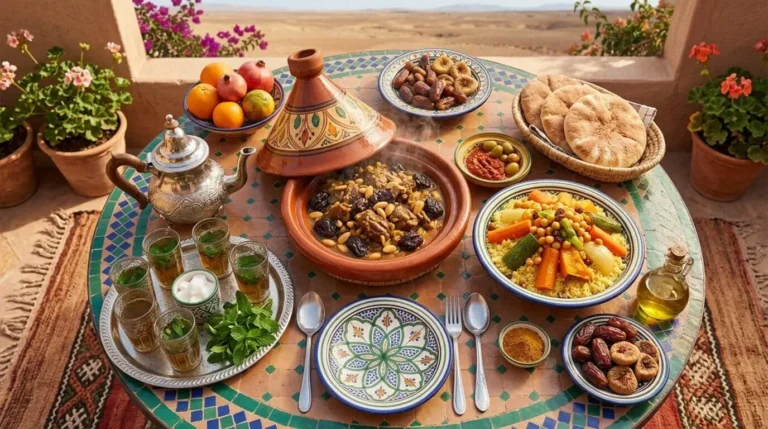
Traditional Moroccan couscous is served in a large communal dish placed at the center of the table, with diners eating from the shared dish using spoons or by rolling balls of couscous in the right hand. For home serving outside Morocco, individual bowls are entirely appropriate — but presenting the full assembled dish at the table before serving individual portions captures something of the communal spirit of the original.
What to Serve with Moroccan Couscous
Harissa: The fiery North African chili paste is served alongside couscous for those who want heat. Place a small bowl on the table and let each person add their own.
Additional broth: A small pitcher of hot broth on the table allows diners to add more moisture to their portion as they eat — traditional and practical.
Moroccan salads: Zaalouk (roasted eggplant and tomato), taktouka (roasted pepper and tomato), and carrot salad with cumin are the classic accompaniments served before the couscous.
Lben (buttermilk): In traditional Moroccan couscous service, a glass of cold lben (a thin, slightly sour buttermilk) is served alongside the couscous to cut through the richness. A cooling and surprisingly effective combination.
Final Thoughts
A Moroccan couscous recipe is a commitment — more time, more technique, and more attention than most Western recipes demand. But the result is a dish of extraordinary depth and generosity that rewards every minute invested. The first time you present a properly assembled couscous at your table — the mound of perfectly steamed grains, the colorful vegetables arranged around the lamb, the fragrant broth steaming from the serving dish — you will understand why this dish has been the centerpiece of Moroccan family life for centuries.
Make it on a Friday. Invite people you love. Eat from a shared dish. And serve mint tea afterward.
For more on Moroccan food culture, read our complete guide to traditional Moroccan dishes and our Moroccan tagine recipe guide. For the best couscous restaurants in Morocco, read our best restaurants in Marrakech guide. For official Moroccan food culture information, visit Visit Morocco.