Common Tourist Scams in Morocco and How to Avoid Them: The Honest 2026 Guide
Tourist scams in Morocco are almost entirely avoidable with the right. The vast majority of Moroccan people are genuinely hospitable, honest, and delighted to share their country with visitors. But Morocco is also a country where tourism is a major economic driver, where the income gap between visitors and locals can be significant, and where certain areas — particularly the tourist-heavy medinas of Marrakech and Fes — have developed a sophisticated ecosystem of small-scale scams targeting visitors who are unfamiliar with local norms.
This guide does not exist to make you paranoid about Morocco. It exists to make you informed. The tourist scams in Morocco that visitors most commonly encounter are almost entirely non-violent, financially minor, and entirely avoidable once you know what to look for. Understanding them before you arrive allows you to navigate Morocco with confidence rather than anxiety — and to distinguish the genuine hospitality that defines the country from the opportunistic approaches that exist in every heavily touristed destination on earth.
The Most Common Tourist Scams in Morocco
The Fake Guide Scam
The most widely reported of all tourist scams in Morocco, the fake guide scam operates in several variations but follows a consistent pattern: a friendly local — often young, often speaking excellent English — approaches you in the medina, strikes up a conversation, and gradually steers the interaction toward an offer to show you around.
The fake guide is the most reported tourist scam Morocco visitors encounter. The destination, invariably, is a carpet shop, leather goods store, or other commercial establishment where the “guide” receives a commission on any purchases you make. The commission — often 30 to 50 percent — is built into the prices offered to you, meaning you pay far more than you would have negotiating independently.
How to avoid it: Licensed official guides in Morocco carry identification cards and are registered with regional tourism authorities. If you want a guided tour, arrange one through your riad or hotel rather than accepting an unsolicited offer on the street. If someone approaches you and you do not want company, a firm but polite “la shukran” (no thank you) repeated without further engagement is usually sufficient.
The Directional “Help” Scam
A variation of the fake guide scam that is particularly common in Fes’s labyrinthine medina: you stop to check your map or phone, and a local offers to help you find your destination. The help is genuine — they do take you where you want to go — but at the destination they ask for payment, presenting the interaction as a professional guiding service rather than a casual act of assistance.
How to avoid it: Download offline maps before entering the medina. When offered directional help, be clear from the outset: “Thank you, I am fine” (or “La shukran, ana bekheer”). If you do accept help from someone who then asks for payment, 20–30 MAD is a reasonable acknowledgment that ends the interaction without significant financial loss.
The Henna Scam
Common in Djemaa el-Fna and the approaches to major tourist sites, the henna scam typically involves a woman approaching you, taking your hand, and beginning to apply henna before you have agreed to anything. Once the design is partially complete, she demands payment — often 200–500 MAD or more for what you may have assumed was a free or voluntary demonstration.
Variations include “complimentary” flower or bracelet gifts that are placed in your hand or attached to your clothing before a payment demand is made.
How to avoid it: Do not extend your hand to anyone offering henna unless you have agreed a price in advance and are happy to pay it. If a flower or bracelet is pressed into your hand, return it immediately rather than accepting it. If you want a genuine henna tattoo, ask at your riad for a recommendation for a trusted artist.
The Overcharging Taxi Scam
As covered in our Morocco taxi guide, petit taxi drivers in tourist-heavy areas — particularly near airports, major hotels, and tourist attractions — frequently quote inflated flat rates to visitors who are unfamiliar with the correct metered fare.
The overcharge is rarely egregious — typically two to three times the metered rate rather than ten times — but it is consistent and, across a week of travel, adds up to a meaningful amount.
How to avoid it: Always insist on the meter (“compteur, s’il vous plaît”). Ask at your accommodation what the correct fare should be before getting into a taxi for important journeys. If a driver insists the meter is broken or unavailable, find another taxi.
The Carpet Shop Invitation
One of the most elaborate tourist scams in Morocco, the carpet shop invitation typically begins with an apparently friendly encounter — someone who “just happens” to be going in the same direction, or who recognizes your nationality and is delighted to practice their English. The conversation naturally leads to an invitation to “see their family’s shop” or “have tea” — and the tea does happen, genuinely and hospitably.
Once in the shop, the full machinery of Moroccan carpet sales is deployed: multiple carpets unrolled, mint tea refilled, prices quoted and negotiated, and considerable social pressure applied to make a purchase. None of this is technically fraudulent — the carpets are real, the tea is real, and some visitors leave very happy with their purchases. The issue is that prices in shops reached through commission-based “guides” are systematically inflated to cover the guide’s cut.
How to avoid it: Visit carpet shops independently and on your own initiative rather than through introductions. The Ensemble Artisanal (government-run fixed-price artisan cooperatives) in major cities sells quality Moroccan crafts at fixed, fair prices and is an excellent reference point for understanding what things should cost.
The Photo Demand
Street performers, snake charmers, and people dressed in traditional costumes in Djemaa el-Fna and similar tourist areas often position themselves specifically to be photographed and then demand payment when tourists take photos — sometimes aggressively.
How to avoid it: If you want to photograph a performer or a person in costume, establish the price before taking the photo. A standard rate of 10–20 MAD per photograph is typical. If someone moves into your frame without invitation and then demands payment, you are not legally obligated to pay, though 10 MAD typically ends the interaction quickly.
The “Free” Spice Shop Tour
Similar to the carpet shop invitation, this scam involves a friendly local who offers to show you the “traditional” spice market or herbal pharmacy, presents an educational tour of different spices and remedies, and then — at the conclusion — reveals that the spices and remedies are available for purchase at prices significantly above market rate.
How to avoid it: Souk spice vendors are worth visiting on your own terms — prices are very negotiable in the open spice market. Avoid accepting guided tours of specific shops unless you have specifically sought them out.
The Mint Tea Obligation Scam
A subtler version of the carpet shop dynamic that operates at the individual level: a vendor offers you mint tea while you browse their stall, then presents the tea as creating an obligation to buy. The social pressure is real in Moroccan culture — accepting hospitality does create a sense of reciprocal obligation — but no legal or ethical obligation to purchase exists.
How to avoid it: If you accept tea in a shop and then decide not to buy, a simple and genuine “thank you, I enjoyed the tea but I am not buying today” with a friendly tone is entirely appropriate. Most vendors accept this graciously; some push harder. Either way, you are not obligated to spend money because you accepted a glass of tea.
The Restaurant Menu Switch
Occasionally reported in tourist-facing restaurants near Djemaa el-Fna: a menu with one set of prices is shown before ordering, and the bill presented at the end reflects different (higher) prices, or items not ordered appear on the bill.
How to avoid it: Check your bill against what you ordered before paying. Photograph the menu before ordering if you are suspicious. Disputes about bills should be handled calmly and firmly — most overcharging of this type is opportunistic rather than systematic and resolves quickly when challenged directly.
Areas Where Tourist Scams in Morocco are Most Common
Djemaa el-Fna, Marrakech: The most concentrated area for tourist scams in Morocco, by virtue of being the single most visited tourist site in the country. The snake charmers, henna artists, and “friendly locals” around the square operate in a well-organized system. Navigate with awareness rather than anxiety — the square is extraordinary and worth multiple visits.
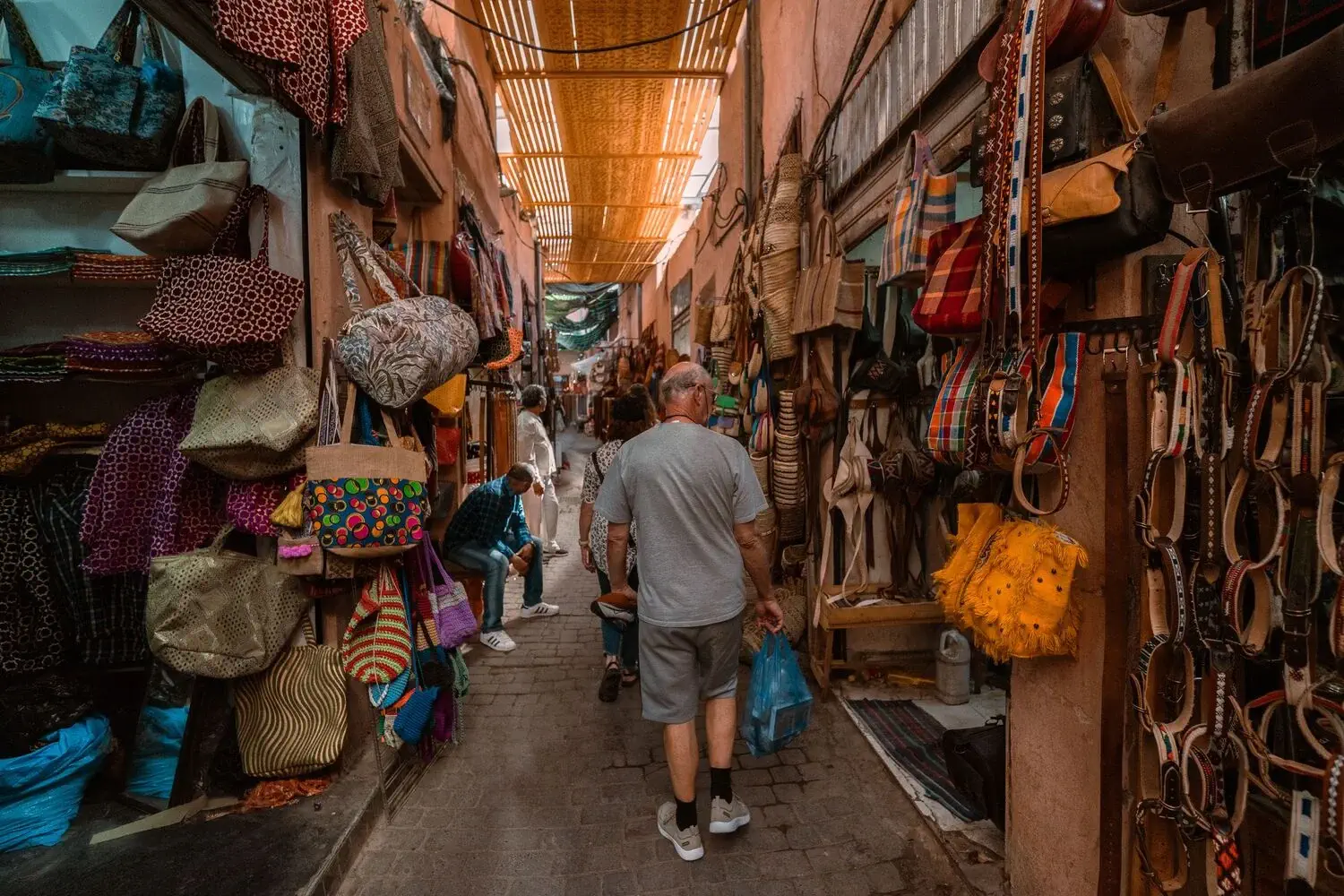
The medina souks of Marrakech and Fes: The labyrinthine souk areas are where fake guides and commission-based shop introductions are most active. Moving with purpose and declining unsolicited offers firmly but politely is the most effective approach.
Airport taxi stands: The transition from airport to city is when visitors are most disoriented and most vulnerable to taxi overcharging. Know the correct rate before you arrive (ask your accommodation) and insist on the meter or the official fixed rate where applicable.
Near major tourist sites: The approaches to Majorelle Garden, the Bahia Palace, and similar major attractions in Marrakech see concentrations of people offering “help” with tickets, directions, or information. None of this help is needed — ticket offices are well-marked and staff are available.
What to Do If You Feel Scammed
In the majority of cases where tourist scams in Morocco have already succeeded — you have paid an inflated taxi fare, bought a carpet at above market price, or paid a guide you did not intend to hire — the practical advice is to treat the experience as education rather than loss. The amounts involved are rarely significant by international standards, and pursuing recovery is usually more stressful than the financial cost warrants.
If you feel genuinely threatened, harassed, or are the victim of a crime (theft, physical intimidation, significant financial fraud), Morocco has tourist police (brigade touristique) in major cities who are specifically tasked with handling these situations. In Marrakech, the tourist police office is located near Djemaa el-Fna.
The Bigger Picture: Morocco Beyond the Scams
It bears repeating that tourist scams in Morocco represent a tiny fraction of the interactions visitors have in the country. For every person attempting to redirect you to a commission shop, there are dozens of genuine shopkeepers, riad owners, restaurant servers, train conductors, mountain guides, and ordinary citizens whose interactions with visitors are defined by the extraordinary Moroccan hospitality that is the country’s most authentic and most durable quality.
Tourist scams in Morocco should never define your experience of this extraordinary country. The goal is to give you the specific knowledge that protects you from the small number of situations where awareness genuinely matters, so that you can engage openly and generously with the vast majority of encounters where that openness is exactly the right response.
For more on Moroccan culture and how to navigate it respectfully, read our complete guide to Moroccan hospitality and customs and our guide to bargaining in the souks. For official tourism safety information, visit Visit Morocco.