Moroccan Wedding Traditions: A Complete Guide to Celebrations, Customs, and Culture
A Moroccan wedding is not an event — it is an experience that unfolds over multiple days, involves an entire community, and draws on centuries of Berber, Arab, and Andalusian tradition to produce one of the most elaborate, colorful, and emotionally intense celebrations on earth. If you are fortunate enough to be invited to a Moroccan wedding during your visit — and invitations to strangers are not uncommon in Morocco, where hospitality extends even to celebrations — accepting without hesitation is the only appropriate response.
This guide to Moroccan wedding traditions covers everything you need to know — the sequence of events, the significance of each ritual, the music and food, the extraordinary bridal costumes, and the cultural context that makes Moroccan weddings so different from anything most Western visitors have encountered.
The Structure of a Moroccan Wedding
The first thing to understand about Moroccan wedding traditions is that a Moroccan wedding is almost never a single-day event. Traditional Moroccan weddings unfold across three to seven days, with each day dedicated to specific rituals, celebrations, and gatherings. Urban weddings in Casablanca and Rabat have compressed in recent decades — a two or three day celebration is increasingly common — but in rural communities and among more traditional families, the full multi-day Moroccan wedding traditions are still observed in their entirety.
The sequence varies by region, family, and religious observance, but the core elements of Moroccan wedding traditions appear across the country in recognizable forms.
The Marriage Contract (Aqd el-Qiran)
Before the celebration begins, the legal and religious foundation of the Moroccan wedding is established through the marriage contract — a formal agreement signed before an adoul (Islamic notary) in the presence of witnesses from both families. The groom and his male representatives meet with the adoul and the bride’s male guardian (wali) to agree and sign the contract, which includes the terms of the mahr — the marriage gift from the groom to the bride, which becomes her exclusive property.
The signing of the marriage contract is a legal requirement under Moroccan family law and is entirely separate from the celebration that follows. It may take place days or weeks before the wedding festivities begin, or on the first day of the Moroccan wedding traditions calendar.
Hammam Day — Preparation and Purification
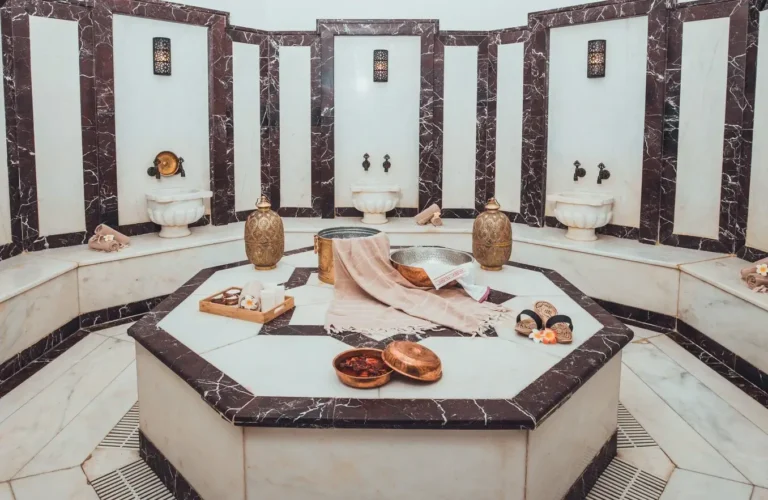
In the days preceding the wedding, the bride visits the hammam — the traditional Moroccan bathhouse — for an elaborate ritual of purification and preparation. This is not a casual visit but a significant element of Moroccan wedding traditions, typically accompanied by her closest female relatives and friends who collectively prepare her body for marriage.
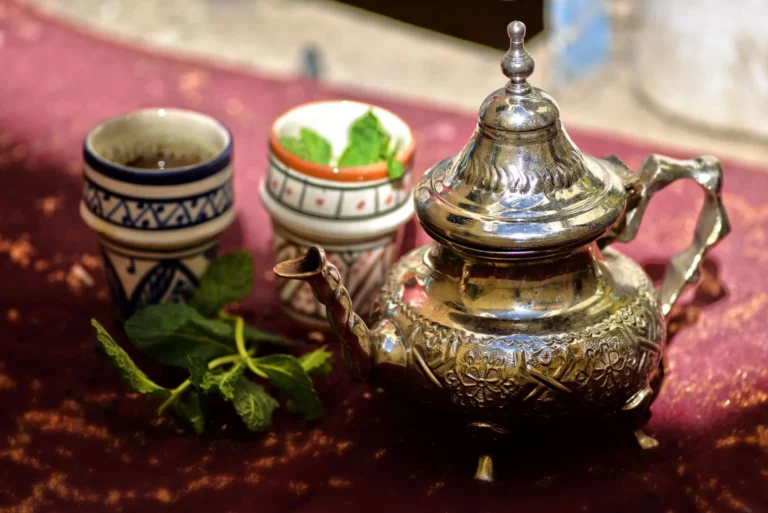
The hammam visit involves a thorough kessa scrub (removing dead skin with a rough mitt), a ghassoul clay treatment for skin and hair, and in many traditions the application of argan oil to leave the skin glowing. The atmosphere is celebratory — singing, laughter, and the passing of sweets and mint tea are all part of the hammam day experience.
Henna Night (Laylat al-Henna)
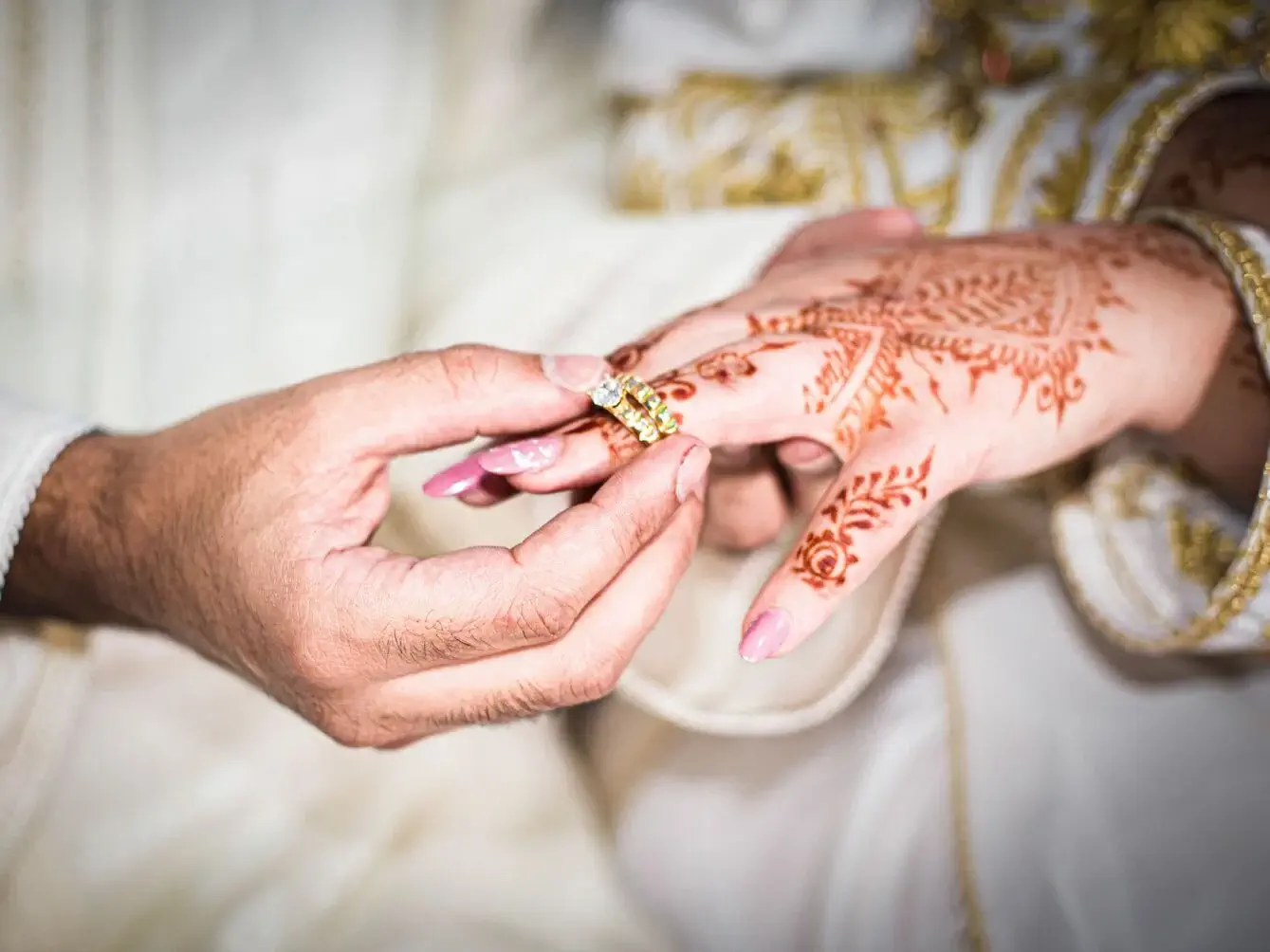
The henna night is one of the most beautiful and most distinctly Moroccan of all Moroccan wedding traditions — an evening dedicated to the ritual application of henna to the bride’s hands and feet, surrounded by female relatives and friends in a celebration of femininity, beauty, and the threshold between girlhood and married life.
Moroccan henna designs differ significantly from the South Asian mehndi patterns that many Western visitors associate with henna. Traditional Moroccan henna patterns are geometric and abstract — bold lines, dots, and angular shapes in the Amazigh (Berber) tradition — rather than the flowing floral patterns of Indian mehndi. In some regions, particularly in the south and in Berber communities, the patterns include symbolic elements with specific meanings — protective symbols against the evil eye, fertility motifs, and family-specific designs passed down through generations of women.
The henna night celebration includes music — typically the women’s percussion ensemble playing traditional Moroccan wedding songs — dancing, the serving of traditional sweets and mint tea, and the gradual application of henna that may take several hours for an elaborate full-hand design. The bride sits at the center of the celebration, attended by a professional henna artist (nqqasha), while female relatives and guests receive simpler designs on their own hands.
The color produced by the henna — ranging from orange through deep red-brown depending on the quality of the paste and the length of time it is left on — is considered propitious. In Moroccan wedding traditions, the depth of the henna color is believed to indicate the depth of the mother-in-law’s affection for the bride.
The Wedding Celebration (Al-Arusa)
The main wedding celebration is the centerpiece of all Moroccan wedding traditions — a gathering that may involve hundreds or even thousands of guests, unfold over an entire night, and incorporate music, dancing, multiple costume changes for the bride, elaborate food, and ceremonial rituals that vary by region and family background.
The Amaria — The Bridal Litter
One of the most spectacular elements of Moroccan wedding traditions is the amaria — a decorated wooden litter or palanquin in which the bride is carried above the heads of the guests at key moments during the wedding celebration. The amaria ceremony involves the bride being lifted and carried around the wedding hall while guests cheer, ululate (the zaghareet — the distinctive high-pitched celebratory sound made by Moroccan women), and shower her with rose petals and blessings.
In some Moroccan wedding traditions, the groom is also carried on an amaria at a different point in the evening. The amaria ceremony is always one of the most emotionally intense and visually spectacular moments of the wedding.
The Bride’s Costume Changes
Among the most distinctive of all Moroccan wedding traditions is the series of costume changes that the bride undergoes throughout the wedding night. A traditional Moroccan bride may change outfits seven or more times during the course of the celebration, each costume representing a different regional tradition, historical period, or family heritage.
The first outfit is typically a white kaftan for the religious ceremony. Subsequent outfits may include:
The takchita — a two-piece formal Moroccan outfit consisting of an underdress (dfina) and an elaborately embroidered overdress (fouqia), fastened at the front with a decorative belt (mdamma). The takchita is the most formal and most elaborate element of Moroccan wedding traditions in terms of dress and may cost thousands of dirhams for a high-quality example.
Regional traditional dress — many brides include at least one outfit that honors their family’s regional heritage. A bride from Fes may wear the traditional Fassi wedding dress with its distinctive embroidery; a bride from Tetouan may appear in Andalusian-influenced costume; a bride from the south may wear Amazigh traditional dress with silver jewelry.
The green kaftan — green is considered an auspicious color in Islamic tradition and a green kaftan appearance at some point during the wedding night is common in Moroccan wedding traditions.
Each costume change is marked by a fresh appearance of the bride before the assembled guests, typically to music and ululation, and her successive appearances in different outfits are among the most anticipated moments of the celebration.
Moroccan Wedding Music
Music is inseparable from Moroccan wedding traditions — a Moroccan wedding without music is simply not a Moroccan wedding. The types of music vary significantly by region, social background, and the preferences of the families involved.
Andalusian music (al-Ala) — the classical music of Morocco’s Andalusian heritage, characterized by intricate melodic modes and elaborate instrumental arrangements. Al-Ala is most associated with weddings in Fes and Tetouan, cities with the strongest Andalusian heritage.
Chaabi — popular Moroccan music that blends Arabic, Berber, and Gnaoua influences into an accessible, celebratory style that fills dance floors. Chaabi is the most common wedding music in urban Morocco.
Gnaoua — the trance music of the Gnaoua brotherhood, rooted in sub-Saharan African spiritual traditions and characterized by deep percussion, call-and-response singing, and the distinctive sound of the guembri (a three-stringed bass lute). Gnaoua is particularly associated with weddings in Marrakech and the south.
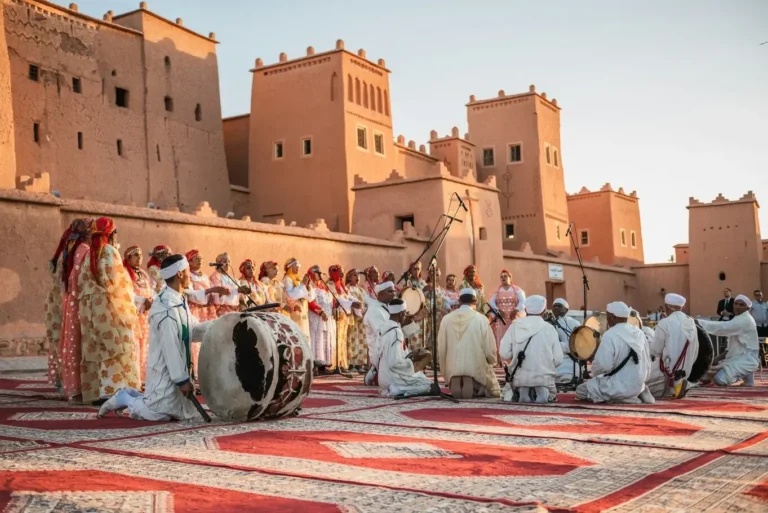
Ahidous and Ahwach — the collective Amazigh music and dance traditions of the Atlas Mountains and the south, performed at Berber weddings with large groups of men and women arranged in circles.
A professional band or ensemble is invariably hired for a Moroccan wedding and may perform continuously for six to eight hours — the celebration typically runs from early evening until dawn.
Moroccan Wedding Food
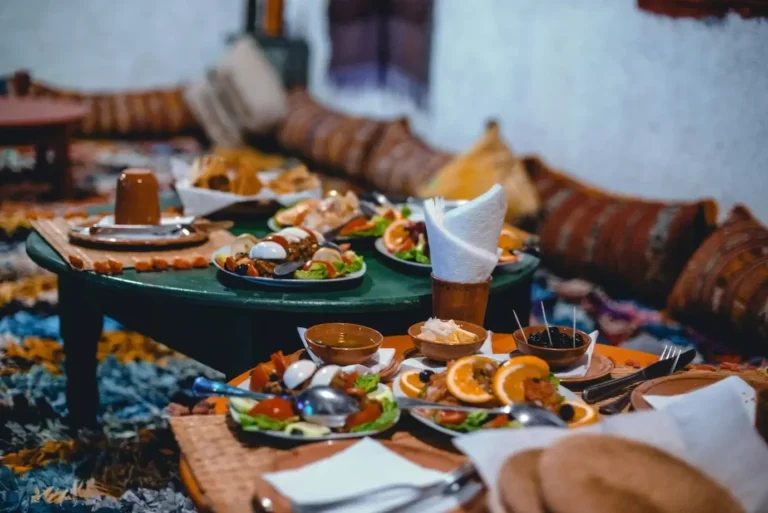
The food served at a traditional Moroccan wedding is both a celebration and a statement of family generosity — the quality and abundance of the food reflects directly on the honor and hospitality of both families. Moroccan wedding traditions around food vary by region but typically include several courses served over the course of the night.
Bastilla — the elaborate savory-sweet pastry pie of pigeon or chicken with almonds and cinnamon, traditionally served at the beginning of formal Moroccan celebrations. At a wedding, bastilla is often made in enormous sizes serving dozens of people.
Mechoui — whole lamb slow-roasted in a clay oven until the meat falls from the bone, served at many Moroccan weddings as the centerpiece of the feast. The sight of an entire roasted lamb carried to the table is one of the most dramatic moments of Moroccan wedding food traditions.
Tagines — multiple tagines of different preparations are typically served at a Moroccan wedding feast: chicken with preserved lemon, lamb with prunes, kefta with eggs, and others.
Couscous — the traditional Friday dish that is also a staple of Moroccan celebrations, typically served toward the end of the main meal as a gesture of abundance and blessing.
Moroccan pastries and sweets — chebakia, kaab el ghazal, briouates filled with almond paste, and an abundance of other Moroccan pastries are served throughout the evening alongside mint tea.
Moroccan Wedding Traditions by Region
Moroccan wedding traditions vary significantly across the country’s diverse regions, reflecting the different ethnic, historical, and cultural influences that have shaped each area.
Fes weddings are characterized by the most elaborate Andalusian music traditions, the most formal dress codes, and the most architecturally beautiful celebration venues — the great riads of the Fes medina have hosted wedding celebrations for centuries.
Marrakech weddings often incorporate Gnaoua music and the more relaxed, sensory atmosphere that characterizes the south. The wedding venues of modern Marrakech — the great tented events spaces on the edge of the city — can accommodate thousands of guests.
Berber weddings in Atlas Mountain and southern Moroccan communities maintain the oldest elements of Moroccan wedding traditions — the collective Ahidous or Ahwach dances that involve the entire community, the emphasis on traditional Amazigh dress and jewelry, and the multi-day structure that urban weddings have largely abandoned.
Sahrawi weddings in the deep south and the former Western Sahara maintain distinctive traditions including the melfa (the flowing blue or white robes worn by Sahrawi women) and musical traditions that reflect the desert nomadic heritage of the region.
What to Wear and How to Behave as a Wedding Guest
If you are fortunate enough to be invited to a Moroccan wedding as a visitor, some guidance on appropriate dress and behavior will help you participate respectfully.
Dress formally. A Moroccan wedding is a formal occasion and guests dress accordingly — men typically wear suits or djellabas; women wear elegant dresses, kaftans, or formal evening wear. Casual clothing is not appropriate.
Arrive late. Moroccan weddings operate on their own time — an invitation for 9 PM may mean the celebration begins at 11 PM or midnight. Arriving precisely on time is not expected and will often find you in an empty venue. Arriving 1–2 hours after the stated time is entirely normal.
Bring a gift. Cash gifts in an envelope are the most practical and most appreciated wedding gift in Moroccan culture. The amount varies by the closeness of the relationship with the family — for a visitor, a modest contribution is entirely appropriate.
Accept food and drink. Refusing the food offered at a Moroccan wedding is considered impolite. Accept everything that is offered and eat as much as you can manage.
Join the dancing. Moroccan weddings are not spectator events — guests are expected to dance, particularly during the Chaabi or Gnaoua sections of the evening. Not knowing the steps is irrelevant; enthusiasm and participation are what matter.
Final Thoughts
A Moroccan wedding is one of the most extraordinary cultural experiences Morocco offers — a multi-day immersion in music, food, beauty, family, and the deep traditions that define Moroccan identity. The elaborate costumes, the henna night, the amaria ceremony, the music that plays until dawn, and the extraordinary generosity of the families who host these celebrations all combine to produce an event unlike anything most Western visitors have experienced.
If you are invited, go. Stay as long as you can. Dance when the music plays. Accept the food and the tea and the pastries. And understand, in the midst of it all, that you are witnessing something that has been celebrated in this way — with these spices, this music, these gestures of hospitality — for centuries.
For more on Moroccan culture and traditions, read our complete guide to Moroccan hospitality, our Moroccan hammam guide, and our guide to Berber culture in Morocco. For official cultural information, visit Visit Morocco.