Toubkal Summit: 7 Amazing Tips for Climbing Morocco’s Highest Peak
Jebel Toubkal stands at 4,167 meters above sea level — the highest point in North Africa, the highest peak in the Arab world, and one of the most accessible high-altitude summits on earth. On a clear morning at the top, with the Sahara visible to the south and the Atlantic glinting on the western horizon, the Toubkal summit delivers one of the most extraordinary panoramas available anywhere in Morocco — or anywhere in Africa.
This guide covers everything you need to know about climbing to the Toubkal summit — the routes, the timing, the equipment, the guides, the accommodation, and the honest physical demands of a climb that is genuinely achievable for fit, determined hikers without technical mountaineering experience.
Why Climb Toubkal?
The Toubkal summit is the defining adventure experience of the Moroccan Atlas Mountains — more accessible than Kilimanjaro, more dramatic than any European peak of similar altitude, and embedded in a landscape of extraordinary beauty and cultural richness that makes the approach as rewarding as the summit itself.
The village of Imlil, the base for all Toubkal summit attempts, is itself a destination — a traditional Berber mountain community set in a valley of walnut trees and terraced fields, surrounded by peaks that rise to over 3,000 meters on all sides. The walk from Imlil to the Toubkal Refuge passes through the village of Around and the Mizane Valley, offering encounters with Atlas Berber communities that have inhabited these mountains for millennia.
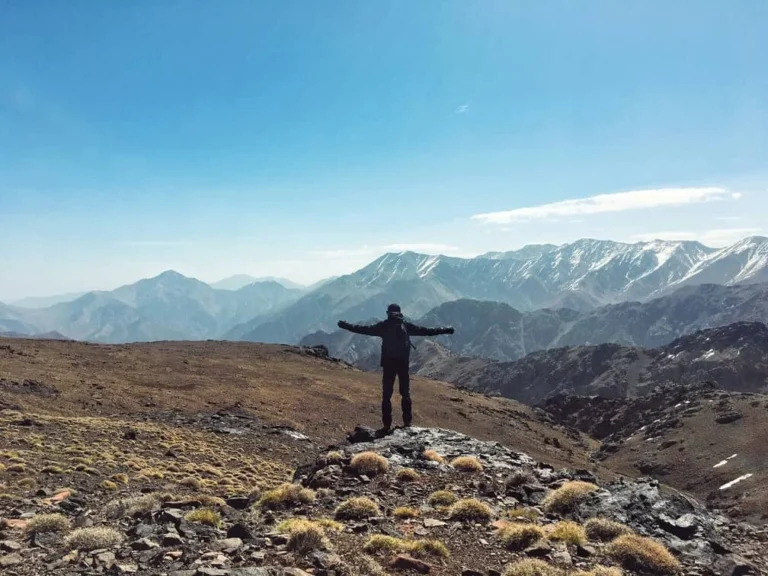
And then there is the summit itself — the physical and psychological reward of standing at the highest point in North Africa, looking down at the cloud layer below and the desert beginning beyond the last foothills. This is why people climb Toubkal.
The Toubkal Summit: Key Facts
- Altitude: 4,167 meters (13,671 feet)
- Location: High Atlas Mountains, approximately 63 kilometers south of Marrakech
- Base village: Imlil (1,740 meters)
- Standard route: Imlil → Around → Toubkal Refuge → Summit → descent
- Total elevation gain: approximately 2,400 meters from Imlil
- Technical difficulty: Non-technical in summer (July–September); requires crampons and ice axe in winter
- Best season: July to September for snow-free conditions; April–June and October for experienced hikers
- Minimum time: 2 days (1 night at refuge); 3 days recommended
Getting to Imlil
Imlil is the starting point for all Toubkal summit attempts and is located approximately 63 kilometers south of Marrakech via Asni.
By grand taxi: Grand taxis run from Marrakech’s Bab er-Rob taxi stand to Asni (approximately 25–30 MAD per seat, 45 minutes), where connecting taxis run to Imlil (approximately 15–20 MAD per seat, 30 minutes). This is the cheapest option.
By private transfer: A private taxi or transfer from Marrakech directly to Imlil costs approximately 250–400 MAD and takes about 1.5 hours. Most Marrakech riads and hotels can arrange this.
By organized tour: Many Marrakech-based tour operators offer Toubkal summit packages including transport from Marrakech, licensed guide, refuge accommodation, and meals. Prices vary from 800–2,000 MAD per person depending on group size and inclusions.
The Standard Toubkal Summit Route
Day 1: Imlil to Toubkal Refuge (4–5 hours)
The first day of the Toubkal summit climb begins in Imlil village (1,740m) and ends at the Toubkal Refuge (3,207m) — a gain of approximately 1,467 meters over 7–8 kilometers.
From Imlil, the path climbs immediately and steeply through the village of Around (1,840m), where the last tea houses and small shops mark the end of settled life and the beginning of the mountain. The path continues up the Mizane Valley, crossing the stream several times on stepping stones and wooden bridges, passing through increasingly barren landscape as the tree line gives way to open rocky slopes.
The gradient throughout Day 1 is steady rather than extreme — experienced hikers find it comfortably challenging; less experienced hikers may find the final two hours demanding. Allow 4–5 hours without rushing, with stops for water and snacks at the multiple rest points along the valley.
The Toubkal Refuge (CAF Refuge du Toubkal) sits at 3,207 meters in a bowl beneath the final summit pyramid. The refuge offers dormitory accommodation (approximately 150–200 MAD per night), meals (dinner and breakfast available), toilets, and running water — basic but entirely adequate for the purpose. Booking in advance is essential between June and September when the refuge can be full. Contact the Club Alpin Français Maroc or book through a local operator.
The evening at the refuge is one of the finest moments of the entire Toubkal summit experience — watching the sunset over the surrounding peaks from 3,200 meters, the valleys far below filling with shadow while the sky above remains luminous for another hour, surrounded by other climbers from across the world with the same goal for the morning.
Day 2: Toubkal Refuge to Summit and Return to Imlil (7–9 hours)
The summit day is the longest and most demanding of the Toubkal summit climb. Most climbers begin between 5 and 6 AM to reach the top before midday clouds build and to allow a comfortable descent and return to Imlil before dark.
Refuge to Summit (3–4 hours):
From the refuge, the path climbs steeply up the South Cwm — a rocky, glaciated valley that in winter is filled with snow and in summer is a river of loose scree and boulders. This section is the most physically demanding of the entire Toubkal summit route — the altitude makes every step more effortful than it would be at sea level, and the scree requires careful foot placement.
The gradient steepens significantly in the final hour below the summit, where the path zigzags up the loose rocky ridge to reach the summit plateau. The final approach to the Toubkal summit cairn involves scrambling over large boulders — hands as well as feet are used — before the flat summit area and the views open up.
The Summit:
The Toubkal summit at 4,167 meters is marked by a large metal pyramid and survey marker. On clear days — which are the majority between July and September — the view extends in every direction: the High Atlas peaks stretching east and west, the pre-Saharan plateaus beginning to the south, and on exceptional days the coastline of the Atlantic visible to the west and the coast of Spain across the Mediterranean to the north.
Allow at least 30–45 minutes at the top. Take photographs. Eat something. Drink water. Appreciate exactly where you are and what you have done to get there.
Summit to Refuge (1.5–2 hours):
The descent from the Toubkal summit back to the refuge follows the ascent route in reverse. The scree section that was hard work going up can be descended more quickly using a controlled sliding technique — experienced mountain guides demonstrate this — but requires care to avoid falling.
Refuge to Imlil (2.5–3 hours):
After collecting your overnight kit from the refuge and eating lunch, the descent to Imlil follows the Day 1 route in reverse. The knees feel the descent more than the ascent — trekking poles are strongly recommended for this section. Most climbers reach Imlil between 3 and 6 PM depending on summit departure time and pace.
The Three-Day Itinerary (Recommended)
For most visitors, the three-day Toubkal summit itinerary is significantly more enjoyable than the compressed two-day version.
Day 1: Marrakech to Imlil. Afternoon acclimatization walk above the village. Night in Imlil gite or small hotel (100–300 MAD per night).
Day 2: Imlil to Toubkal Refuge via the standard route. Afternoon rest and acclimatization at altitude. Night at the refuge.
Day 3: Summit attempt and return to Imlil. Transfer back to Marrakech.
The additional night in Imlil allows partial acclimatization before ascending to the refuge, significantly reducing the risk of altitude-related symptoms and improving the quality of the summit day experience.
Hiring a Guide for the Toubkal Summit
A licensed mountain guide is strongly recommended for the Toubkal summit, particularly for first-time visitors to the High Atlas. The route is well-marked in summer but the mountain weather can change rapidly, route-finding in poor visibility requires experience, and the physical and motivational support of an experienced guide makes a significant difference on summit day.
Licensed guides for the Toubkal summit can be arranged in Imlil — the Bureau des Guides in the village maintains a register of licensed guides and can match you with an appropriate guide based on your experience and language preference. The cost for a licensed guide is approximately 400–600 MAD per day, plus the guide’s accommodation and meals at the refuge.
A mule (and handler) can also be hired in Imlil to carry your main pack to the refuge, allowing you to walk with only a light daypack. Mule hire costs approximately 200–350 MAD per day and is strongly recommended for less experienced hikers or those with heavy packs.
What to Pack for the Toubkal Summit
Packing correctly for the Toubkal summit is one of the most important preparations you can make. The mountain weather is unpredictable, temperatures drop significantly at altitude, and the consequences of being under-equipped at 4,000 meters are serious.
Essential:
- Sturdy hiking boots with ankle support (already broken in — do not attempt Toubkal in new boots)
- Trekking poles (strongly recommended — essential for the scree descent)
- Warm layers: fleece mid-layer, down jacket or equivalent
- Waterproof outer shell (wind and rain protection)
- Hat and gloves (even in summer — the summit can be bitterly cold)
- Sun protection: SPF 50 sunscreen, UV-blocking sunglasses, sun hat
- Headlamp with fresh batteries (for the pre-dawn summit departure)
- At least 2 liters of water capacity (fill at the refuge before the summit attempt)
- High-energy snacks: nuts, dried fruit, chocolate, energy bars
- First aid kit including blister treatment and pain relief
For winter ascents (November–April):
- Crampons (10 or 12 point — not microspikes)
- Ice axe
- Gaiters
- Winter-rated sleeping bag
Leave in Imlil:
- Main luggage (leave at your accommodation or with the mule handler)
- Anything not needed for the two summit days
Altitude Sickness on the Toubkal Summit
Altitude sickness (acute mountain sickness, AMS) is a genuine consideration for the Toubkal summit, particularly for visitors arriving directly from sea level. At 4,167 meters, the air contains approximately 40 percent less oxygen than at sea level, and the body requires time to adapt.
Symptoms of AMS include headache (the most common symptom), nausea, fatigue, dizziness, and difficulty sleeping. Mild AMS is very common on the first night at the refuge (3,207m) and usually resolves with rest and adequate hydration. More serious symptoms — severe headache unresponsive to ibuprofen, vomiting, confusion, difficulty walking — require immediate descent.
The standard prevention measures apply:
Ascend slowly. The three-day itinerary with a night in Imlil before ascending to the refuge provides meaningful partial acclimatization.
Stay hydrated. Drink at least 3–4 liters of water per day throughout the climb. The dry mountain air accelerates dehydration significantly.
Avoid alcohol. Alcohol significantly worsens altitude sickness symptoms and should be avoided from the day before the climb.
Consider medication. Acetazolamide (Diamox) is a prescription medication that reduces the incidence and severity of AMS. Consult a doctor before departure if you are concerned about altitude sickness — it is particularly worth considering for visitors with a history of altitude problems or those planning a very fast ascent.
Know when to descend. If symptoms worsen rather than improve with rest, descend immediately. There is no summit worth serious health risk.
Best Time to Climb Toubkal
July to September: The prime season for the Toubkal summit. Snow-free conditions on the standard route, stable weather, and long days make this the most straightforward time to climb. The refuge is at its busiest — book well in advance.
April to June: Partial snow coverage requires care and potentially crampons on the upper mountain. The landscape is at its most beautiful — wildflowers in the valleys, snow on the peaks. An excellent time for experienced hikers.
October to November: Autumn brings cooler, clearer air and significantly fewer climbers. Early October is often excellent; November sees the first serious snowfalls.
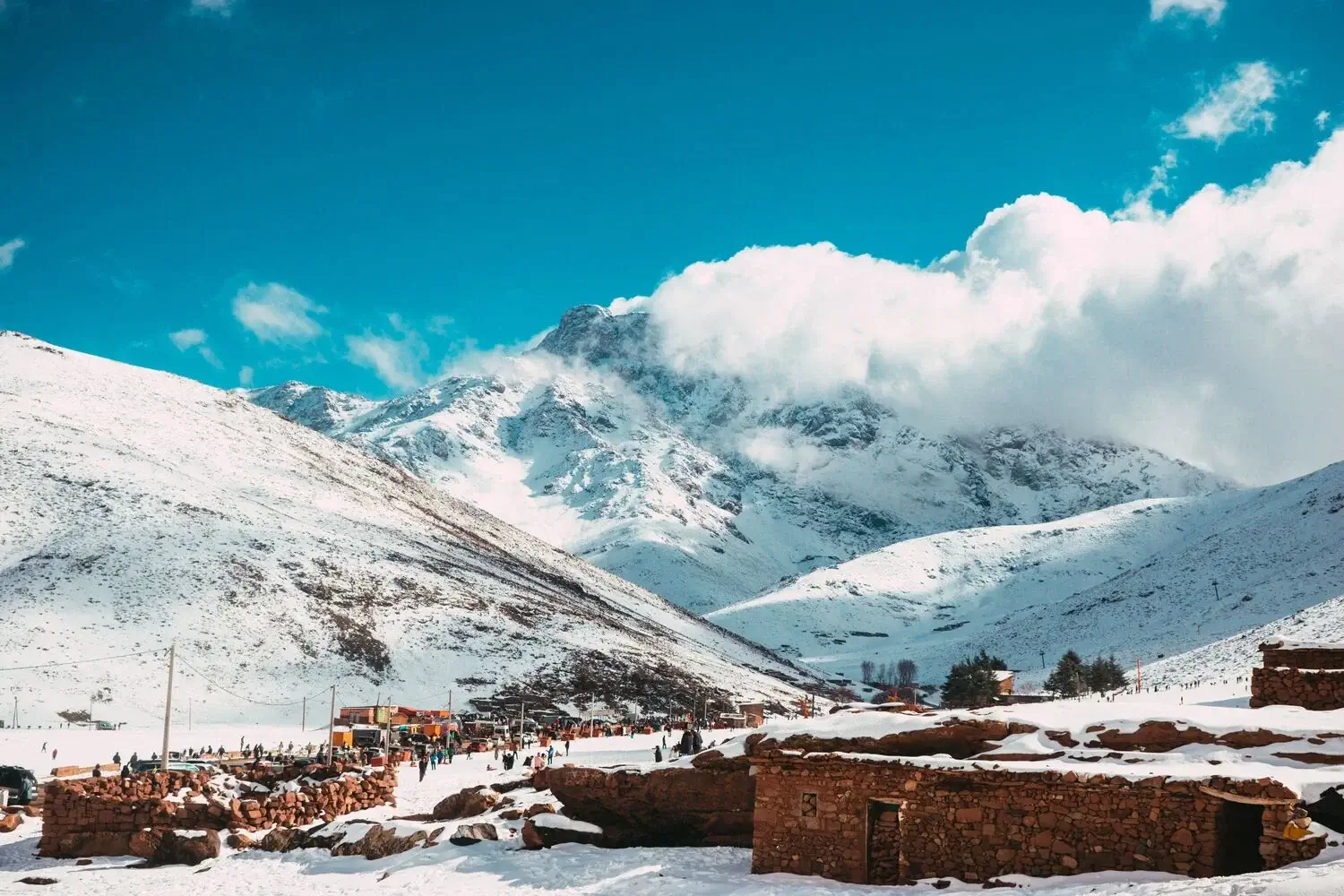
December to March: Winter Toubkal summit attempts are serious undertakings requiring winter mountaineering equipment and experience. The summit is covered in deep snow, temperatures at the refuge can reach -20°C, and the summit approach requires crampons and ice axe technique. Only for experienced winter mountaineers with appropriate equipment.
Accommodation in Imlil
Gites: Basic guesthouses in Imlil and the surrounding villages offer dormitory accommodation for 80–150 MAD per night, or private rooms for 200–350 MAD. Meals are typically available for an additional charge.
Kasbah du Toubkal: The finest accommodation in the Imlil area — a beautifully converted kasbah in the village of Around (20 minutes walk from Imlil) with stunning mountain views, excellent food, and a level of comfort that is genuinely unexpected at this altitude. A portion of revenues supports local community development. Expect to pay 800–2,000 MAD per night depending on room type.
Final Thoughts
The Toubkal summit is one of those experiences that recalibrates perspective in the way that only physical challenge combined with extraordinary beauty can. The aching legs on the scree descent, the pre-dawn cold of the summit morning, the thin air that makes every step above 3,500 meters an act of conscious effort — all of these are inseparable from the reward of the summit itself and the view that makes every difficulty immediately worthwhile.
It is not technically difficult. It is physically demanding. It requires preparation, appropriate equipment, and realistic expectations about what altitude does to the body. But it is achievable by any reasonably fit person who is properly prepared — and the achievement, once accomplished, is not easily forgotten.
For more Morocco adventure, read our complete Atlas Mountains hiking guide and our Sahara Desert Tour from Marrakech guide. For the complete Marrakech base, read our 3 Days in Marrakech itinerary. For official mountain guide information, visit Visit Morocco.