
Atlas Mountains Hiking: The Complete Guide to Morocco’s 7 Best Trails
The Atlas Mountains are one of Africa’s great mountain ranges, stretching over 2,500 kilometers across Morocco, Algeria, and Tunisia and reaching their highest point at Jebel Toubkal — at 4,167 meters, the highest peak in North Africa and the Arab world. For hikers and trekkers, the Moroccan Atlas offers an extraordinary range of experiences, from gentle half-day walks through Berber villages to demanding multi-day ascents that rival anything available in the Alps.
This guide covers everything you need to know about atlas mountains hiking in Morocco — the best trails for every level of experience, the essential practicalities of planning a trek, what to pack, when to go, and how to make the most of one of the world’s most rewarding mountain destinations.
The Three Ranges of the Moroccan Atlas
Before planning atlas mountains hiking in Morocco, it helps to understand that the Atlas is not a single range but three distinct mountain systems, each with its own character, altitude, and hiking opportunities.
The High Atlas is the highest and most dramatic of the three ranges, home to Jebel Toubkal and the classic trekking routes that attract serious hikers from around the world. The High Atlas runs northeast from Agadir to the Algerian border, reaching its greatest heights in the area south of Marrakech. This is where most atlas mountains hiking takes place.
The Middle Atlas sits north of the High Atlas and is characterized by cedar forests, volcanic lakes, and gentler terrain. The Middle Atlas is less visited by trekkers but offers beautiful hiking through landscapes that feel completely different from the dramatic peaks of the south. The area around Azrou and Ifrane is particularly attractive.
The Anti-Atlas runs parallel to the High Atlas further south, forming a dramatic barrier between the mountains and the Sahara. The Anti-Atlas offers remote, arid trekking through landscapes of extraordinary geological variety, including the famous Jebel Sirwa and the rose-scented Dades and Todra Gorges.
The Best Trails for Atlas Mountains Hiking
Jebel Toubkal Summit — The Classic High Atlas Trek
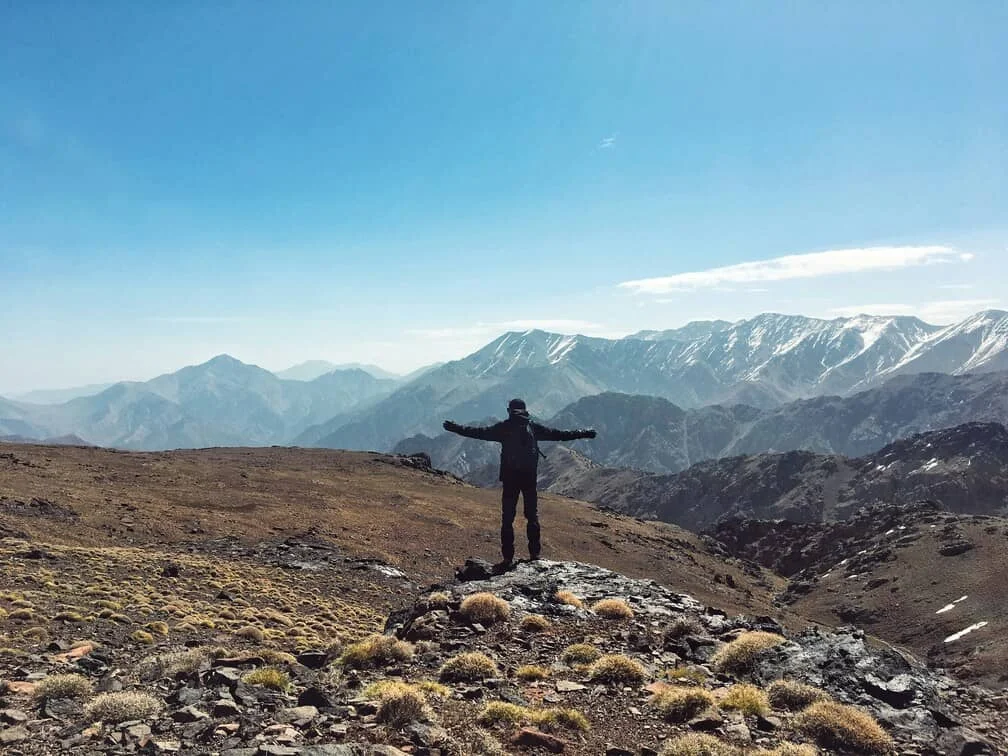
The ascent of Jebel Toubkal is the most famous atlas mountains hiking route in Morocco and one of the most popular high-altitude treks in Africa. The summit stands at 4,167 meters and offers views that extend, on clear days, from the Sahara in the south to the Atlantic Ocean in the west.
Difficulty: Moderate to challenging. The summit does not require technical climbing skills or specialist equipment in summer, but the altitude and steep terrain demand good fitness and a steady pace.
Duration: Most trekkers complete the Toubkal circuit in two days — one day to hike from Imlil to the Toubkal Refuge (approximately 5–6 hours) and a second day to summit and descend (approximately 8–10 hours total). Stronger hikers occasionally complete the round trip in a single very long day, but this is not recommended.
Starting Point: Imlil, a small village approximately 60 kilometers south of Marrakech, is the base for all Toubkal atlas mountains hiking. Grand taxis run from Marrakech to Imlil for approximately 30–40 MAD per seat, or you can hire a private transfer for 200–350 MAD.
Accommodation: The Toubkal Refuge (CAF Refuge du Toubkal) sits at 3,207 meters and offers dormitory accommodation and meals. Booking in advance is essential in summer. Cost is approximately 150–200 MAD per night for a dormitory bed.
Guide Requirement: A licensed mountain guide is strongly recommended for the Toubkal summit, particularly for first-time visitors to the High Atlas. The trail is well-marked but the mountain weather can change rapidly and the descent from the summit requires careful navigation. Guides can be arranged in Imlil for approximately 400–600 MAD per day.
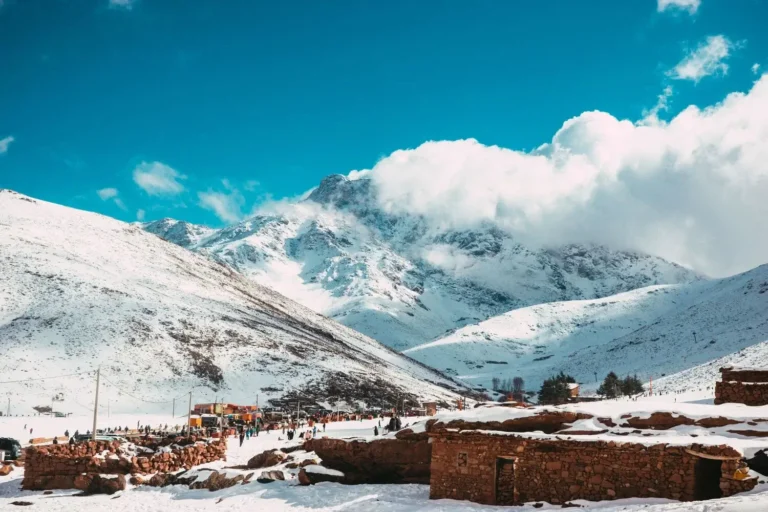
Best Season: July to September offers the most reliable weather for atlas mountains hiking to the Toubkal summit. Snow covers the upper mountain from November through May, and while winter ascents are possible with crampons and ice axes, they require experience and proper equipment.
The Toubkal Circuit — A Multi-Day High Atlas Trek
For trekkers who want more than a single summit, the Toubkal Circuit is one of the finest multi-day atlas mountains hiking experiences in Morocco. The circuit typically takes four to five days and traverses several high passes (known locally as tizi) above 3,000 meters, passing through remote Berber villages, crossing dramatic ridgelines, and offering constantly changing views of the High Atlas.
The standard circuit route begins in Imlil, crosses the Tizi n’Ouanoums pass (3,664m), descends to the village of Ait Benhaddou (not the famous kasbah — a different settlement), traverses to the village of Azib Tamsoult, climbs to the Toubkal summit, and returns to Imlil via the standard route.
Difficulty: Challenging. Several days involve seven to nine hours of hiking with significant elevation gain and loss. Good physical fitness is essential.
Cost: A fully supported Toubkal Circuit trek with guide, mule (to carry luggage), accommodation in mountain refuges and local gites, and all meals typically costs 800–1,500 MAD per person per day depending on group size and level of service.
The Ourika Valley — Easy Atlas Mountains Hiking Near Marrakech
For visitors to Marrakech who want to experience atlas mountains hiking without committing to a multi-day expedition, the Ourika Valley offers an accessible and beautiful introduction to the High Atlas. Located approximately 60 kilometers south of Marrakech, the valley is one of the most popular day trip destinations from the city.
The main trail in the Ourika Valley leads to the Setti Fatma waterfalls, a series of seven cascades set in a lush gorge above the valley floor. The hike to the lower falls takes approximately 45 minutes each way on a well-maintained path and is suitable for almost any fitness level. The upper falls require an additional two hours of more challenging scrambling.
Getting There: Grand taxis run from Marrakech’s Bab er-Rob taxi stand to the village of Setti Fatma at the end of the Ourika Valley for approximately 30–50 MAD per person. The journey takes about one hour.
Best Time to Visit: Spring (March to May) and autumn (September to November) are the best seasons for Ourika Valley atlas mountains hiking. The waterfalls are most impressive in spring when snow melt swells the river. Summer can be uncomfortably hot in the lower valley.
The M’Goun Massif — Remote High Atlas Trekking
West of Toubkal, the M’Goun Massif offers what many experienced atlas mountains hiking guides consider the finest trekking in Morocco. Centered on Jebel M’Goun (4,071m, the second highest peak in the Atlas), the massif is characterized by dramatic gorges, remote Berber communities, rose plantations (the area produces much of Morocco’s famous rose water), and a landscape that sees a fraction of the visitors who flock to Toubkal.
The classic M’Goun traverse is a five to seven day trek that crosses the massif from north to south or east to west, passing through the Arous and Tessaout valleys and crossing several high passes. This route is genuinely remote — villages along the way have limited facilities and no reliable communications — and requires a licensed guide, mules, and full camping or gite accommodation arrangements.
Starting Points: Azilal (north approach) or Kelaat M’Gouna, known as the Rose City, on the south approach.
The Todra and Dades Gorges — Trekking in the Anti-Atlas
At the eastern edge of the High Atlas where the mountains plunge toward the Sahara, the Todra and Dades Gorges offer spectacular atlas mountains hiking in a landscape of extraordinary geological drama. Sheer rock walls rise 300 meters above narrow canyon floors carved by rivers over millions of years.
The Todra Gorge is internationally famous among rock climbers, but hikers can also follow trails up the gorge and into the surrounding plateau for views that combine High Atlas peaks with the beginnings of the Saharan landscape. A guided half-day hike from the gorge to the plateau above costs approximately 200–300 MAD.
Essential Practical Information for Atlas Mountains Hiking
What to Pack
Atlas mountains hiking demands proper preparation even for shorter day hikes. The altitude means temperatures drop rapidly after sunset and weather can change unexpectedly at any time of year.
For day hikes in the Ourika Valley or lower elevations, bring: sturdy walking shoes or trail runners, sun protection (hat, sunscreen, sunglasses), at least two liters of water per person, snacks, a light jacket or fleece for the cooler morning and evening temperatures, and a small first aid kit.
For multi-day treks to Toubkal or the M’Goun Massif, add: a four-season sleeping bag (three-season minimum), trekking poles (strongly recommended for the steep descents), warm layers including a down jacket, waterproof outer shell, gaiters, and headlamp with spare batteries. Altitude sickness medication (acetazolamide) should be discussed with a doctor before departure for anyone planning to go above 3,000 meters.
Hiring a Guide and Mules
Licensed mountain guides for atlas mountains hiking can be arranged in Imlil (for Toubkal routes), Azilal (for M’Goun), or through tour operators in Marrakech. Always verify that your guide holds an official license from the Moroccan Ministry of Tourism — licensed guides carry identity cards and are registered with the relevant authorities.
Mules are widely used on multi-day atlas mountains hiking routes to carry luggage, food, and camping equipment. A mule with its handler costs approximately 250–400 MAD per day and transforms a physically demanding expedition into a genuinely comfortable experience, allowing you to walk with only a light daypack.
Altitude Sickness
Altitude sickness is a genuine consideration for atlas mountains hiking above 3,000 meters, particularly for visitors arriving directly from sea level. Symptoms include headache, nausea, fatigue, and difficulty sleeping. The standard advice — ascend slowly, stay hydrated, descend immediately if symptoms worsen — applies equally in the Atlas as in any other high-altitude environment.
Most healthy adults can ascend to the Toubkal summit (4,167m) without significant altitude problems if they allow a proper acclimatization night at the refuge (3,207m) before the final ascent.
Where to Stay in Imlil
Imlil, the main base for Toubkal atlas mountains hiking, has an excellent range of accommodation options from budget gites (100–200 MAD per night for a dormitory bed) to comfortable guest houses with private rooms (300–600 MAD per night). Kasbah du Toubkal, located in the nearby village of Aremd, is one of Morocco’s finest mountain lodges and offers a memorable base for High Atlas trekking at higher rates.
The Best Time for Atlas Mountains Hiking
Spring (April to June): Arguably the finest season for atlas mountains hiking in Morocco. The snow is retreating from the lower passes, wildflowers carpet the valley floors, the streams are running high from snowmelt, and the days are long and mostly clear. This is the recommended season for the Ourika Valley and for most routes below 3,500 meters.
Summer (July to September): The peak season for Toubkal summit attempts. The mountain is snow-free, the weather is most stable, and the days are long enough for a comfortable ascent. The high valleys can be busy in August.
Autumn (October to November): A beautiful season for atlas mountains hiking, with clear skies, comfortable temperatures, and dramatically fewer visitors than summer. An excellent time for multi-day treks.
Winter (December to March): The High Atlas above 2,500 meters is under snow and requires winter trekking experience, crampons, and ice axes. The lower valleys around the Ourika can be hiked year-round but cold temperatures and short days limit what is possible.
Final Thoughts
Atlas mountains hiking offers experiences that stay with a traveler for a lifetime — the silence of the high passes at dawn, the hospitality of Berber families in remote valley villages, the extraordinary physical satisfaction of standing on Toubkal’s summit with the Sahara visible to the south and the Atlantic to the west. Whether you have a single afternoon for a walk in the Ourika Valley or two weeks for a traverse of the M’Goun Massif, the Atlas Mountains of Morocco will exceed every expectation.
For more Morocco adventure planning, read our Sahara Desert Tour from Marrakech guide and our 3 Days in Marrakech itinerary for the best way to combine the city and the mountains. For official trekking information, visit Visit Morocco.
4 Comments