Moroccan Argan Oil: The Complete Guide to Morocco’s Liquid Gold
Moroccan argan oil is one of the world’s most remarkable natural products — a golden, fragrant oil pressed from the kernels of the argan tree (Argania spinosa) that grows wild in a UNESCO Biosphere Reserve in southwestern Morocco and nowhere else on earth. Known as “liquid gold” for its extraordinary properties and its economic value to the Berber communities that produce it, Moroccan argan oil has become globally celebrated as both a culinary delicacy and a cosmetic ingredient of exceptional quality.
This complete guide to Moroccan argan oil covers everything you need to know — the extraordinary story of the argan tree, the traditional production process, the difference between culinary and cosmetic argan oil, how to identify authentic versus adulterated oil, where to buy genuinely high-quality Moroccan argan oil at fair prices, and how the argan cooperatives are transforming the lives of Berber women across southwestern Morocco.
The Argan Tree: Morocco’s Most Extraordinary Natural Resource
The argan tree is one of the most remarkable trees on earth — a gnarled, thorny, drought-resistant species that has survived for millions of years in the semi-arid landscapes of southwestern Morocco, between Essaouira and Agadir, in a zone that UNESCO designated as the Arganeraie Biosphere Reserve in 1998.
The argan tree is extraordinarily long-lived — individual trees can survive for 200 years or more — and extraordinarily resilient, capable of surviving on minimal rainfall in rocky, nutrient-poor soils where almost nothing else grows. Its extensive root system prevents soil erosion and maintains the fragile ecological balance of the pre-Saharan landscape. The tree produces a fruit similar in appearance to a large olive, with a fleshy outer layer surrounding a hard nut that contains one to three kernels from which the oil is pressed.
The argan forest covers approximately 800,000 hectares of southwestern Morocco and supports the livelihoods of approximately 2–3 million people — through the oil production itself, through the grazing of goats in the forest (argan-browsing goats, which climb the trees to eat the fruit, are one of Morocco’s most photographed and most improbable spectacles), and through the broader economic activity that the argan economy generates.
The argan tree is listed as a vulnerable species by the IUCN — the increasing global demand for Moroccan argan oil, combined with agricultural expansion and drought, has placed pressure on the forest. Sustainable management of the argan ecosystem is one of the central environmental challenges facing southwestern Morocco.
How Moroccan Argan Oil is Made
The traditional production of Moroccan argan oil is a labor-intensive process performed almost exclusively by Berber women and has been practiced in essentially the same form for centuries.
Traditional Hand Production
Step 1 — Collecting the fruit: Argan fruit falls naturally from the trees in summer. It can be collected directly from the ground or — in the traditional method — goats are allowed to browse the trees and the fruit passes through their digestive systems intact, the hard nut unaffected by digestion. The “goat-processed” argan nuts are traditionally considered to produce oil of the same quality as direct-collected fruit, though many modern producers avoid this step.
Step 2 — Drying: The collected fruit is dried in the sun for several weeks, during which the outer fleshy layer shrinks and separates from the nut beneath.
Step 3 — Removing the flesh: The dried flesh is removed from the nut by hand — a simple but time-consuming process performed by women sitting in groups, often singing traditional songs while they work.
Step 4 — Cracking the nuts: The argan nut is extraordinarily hard — significantly harder than most commercially processed nuts — and cracking it to extract the kernels within requires both skill and force. Traditionally, Berber women crack the nuts by striking them between two stones with practiced accuracy. This is one of the most labor-intensive steps in traditional Moroccan argan oil production — approximately 20 hours of hand-cracking is required to produce one liter of oil.
Step 5 — Roasting (for culinary oil only): Kernels destined for culinary Moroccan argan oil are lightly roasted over low heat before pressing — a step that develops the distinctive nutty, toasty flavor that makes culinary argan oil so remarkable. Kernels for cosmetic argan oil are not roasted.
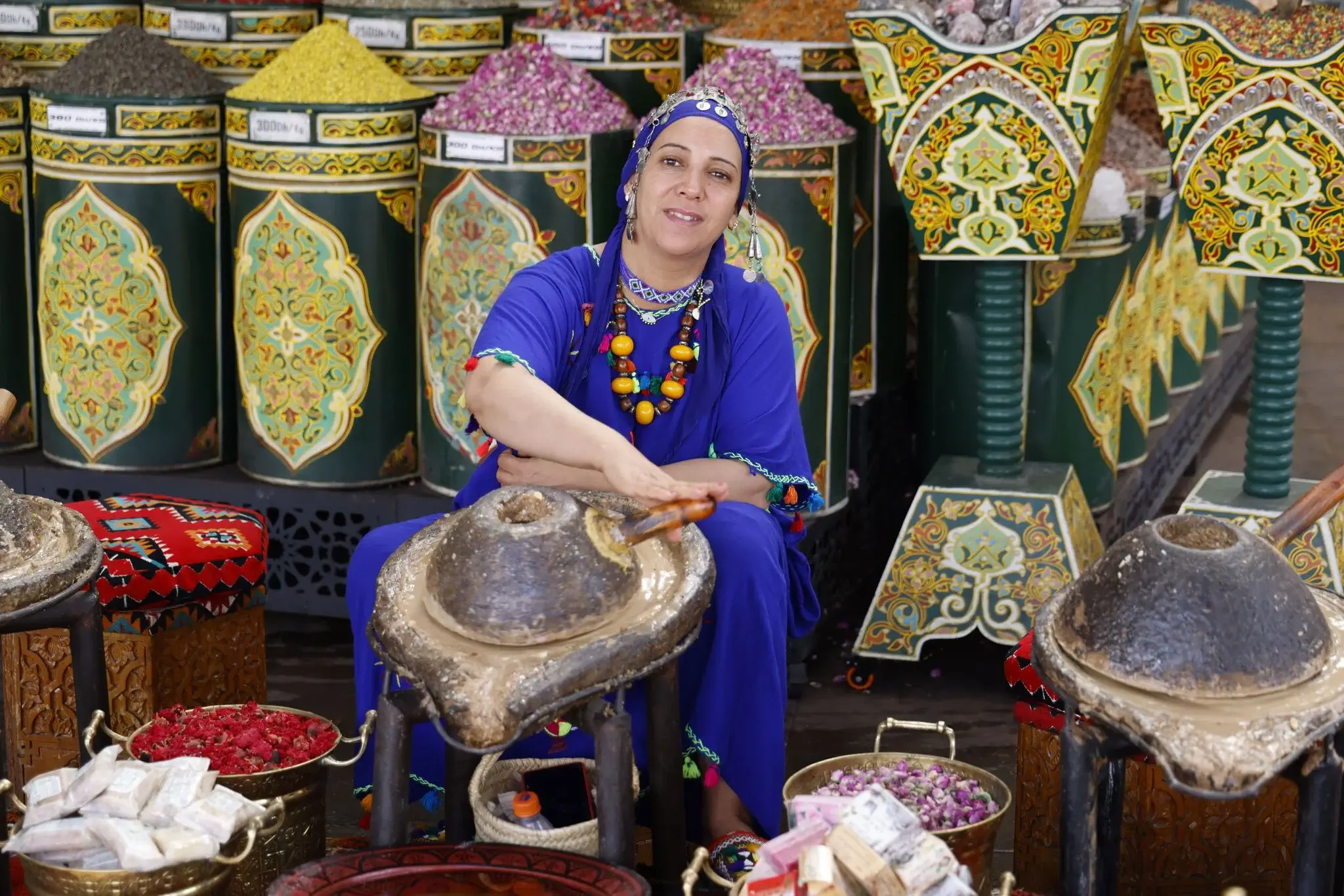
Step 6 — Cold pressing: The kernels are ground — traditionally by hand using a stone mill (rotary quern) — into a paste, which is then kneaded by hand with small amounts of water until the oil separates and can be extracted. This traditional cold-pressing method preserves all the nutritional compounds and aromatic qualities of the oil.
Modern production facilities use mechanical cold-pressing that is significantly faster and more consistent, though the finest traditional producers argue that hand-pressed oil retains superior qualities.
Understanding the Labor
The labor required to produce authentic hand-pressed Moroccan argan oil is extraordinary — approximately 15–20 hours of work for one liter of oil, including nut collection, drying, flesh removal, nut cracking, kernel roasting, and pressing. This labor intensity explains why genuine Moroccan argan oil commands the prices it does — and why suspiciously cheap argan oil products are almost certainly adulterated.
Culinary Argan Oil vs. Cosmetic Argan Oil
One of the most important distinctions in Moroccan argan oil is the difference between the culinary and cosmetic varieties — they are produced from the same tree and the same kernels but through different processes and for entirely different uses.
Culinary Moroccan Argan Oil
Culinary argan oil is made from lightly roasted kernels and has a distinctive rich, nutty, toasty flavor — often described as a combination of hazelnut and sesame with a uniquely Moroccan character. It has a dark golden to amber color and an intense aroma that fills the kitchen when the bottle is opened.
Culinary Moroccan argan oil is used as a finishing oil — drizzled over salads, couscous, and tagines, stirred into sauces, or eaten with bread as a dipping oil. It is not suitable for cooking at high temperatures (its smoke point is too low for frying) but is exceptional when used uncooked or added to warm dishes just before serving.
The finest culinary use of Moroccan argan oil: Amlou — the traditional Berber paste of toasted almonds, argan oil, and honey that is eaten for breakfast with bread throughout southwestern Morocco. For the recipe and cultural context, read our Moroccan breakfast food guide.
Nutritional profile of culinary argan oil: Moroccan argan oil is extraordinarily rich in oleic acid (the same fatty acid that makes olive oil beneficial) and linoleic acid, as well as tocopherols (vitamin E), polyphenols, and plant sterols. It has a higher antioxidant content than olive oil and is considered one of the most nutritionally beneficial edible oils available.
Cosmetic Moroccan Argan Oil
Cosmetic argan oil is made from unroasted kernels and has a lighter color, milder scent, and a different fatty acid profile optimized for skin and hair absorption. It is used as a moisturizer, hair treatment, nail conditioner, and base for cosmetic formulations.
Cosmetic Moroccan argan oil has achieved global popularity in the beauty industry — appearing as a key ingredient in shampoos, conditioners, serums, and skincare products worldwide. The properties that make it so effective cosmetically include its high concentration of tocopherols (antioxidants that protect skin from environmental damage), its fatty acid profile (which closely matches the skin’s natural sebum), and its absorption rate (it penetrates the skin without leaving a greasy residue).
Never confuse culinary and cosmetic argan oil. They look similar but taste completely different — cosmetic argan oil has a mild, slightly unpleasant flavor that makes it entirely unsuitable for eating, while culinary argan oil is too intensely flavored for most cosmetic applications.
The Women’s Argan Cooperatives
The most significant development in the Moroccan argan oil economy over the past three decades has been the establishment of women’s cooperatives that produce and market argan oil collectively, providing Berber women with income, economic independence, and social status that traditional agricultural and domestic roles did not previously afford.
The first argan oil cooperative was established in the 1990s and the model has since been replicated across the argan forest region — there are now hundreds of cooperatives employing tens of thousands of women, producing certified high-quality Moroccan argan oil for both domestic and international markets.
How the Cooperatives Work
Women members of an argan cooperative collect nuts from the trees on community land, process them at a shared facility equipped with both traditional hand tools and modern cold-pressing equipment, and share the proceeds of oil sales according to their contribution of labor. The cooperative model provides several critical advantages over individual production:
Quality control: Cooperative production facilities maintain consistent quality standards that individual home production cannot guarantee. Most certified cooperatives test their oil for purity and nutritional profile.
Fair certification: Many cooperatives hold organic certification, fair trade certification, or both — ensuring that the women who produce the oil receive a fair share of the price paid by international buyers.
Social dimension: The cooperative workspace provides a social environment where women share knowledge, support each other, and maintain traditional skills that might otherwise be lost. The collective singing that traditionally accompanies nut-cracking continues in cooperative facilities today.
Economic impact: Women who work in argan cooperatives typically earn significantly more than those engaged in traditional agricultural work, and the income goes directly to women rather than through household male gatekeepers.
Visiting a Cooperative
Visiting an argan oil cooperative is one of the most rewarding cultural experiences available in southwestern Morocco and a highlight of any visit to the Essaouira-Agadir region. Most cooperatives welcome visitors and offer demonstrations of the nut-cracking and oil-pressing process, along with the opportunity to purchase certified authentic Moroccan argan oil directly from the producers.
Notable cooperatives to visit:
Coopérative Marjana (near Essaouira): One of the oldest and most respected cooperatives in the region, with an excellent visitor experience and certified organic and fair trade oil.
Coopérative Amal (near Tiznit): A well-organized cooperative with a clear demonstration process and high-quality oil. Particularly recommended for travelers heading toward Agadir.
Association Tifaout (near Taroudant): A smaller cooperative with an authentic, unpolished visitor experience that gives the clearest picture of traditional production methods.
Visiting a cooperative directly rather than purchasing argan oil from a Marrakech souvenir shop or a roadside stall ensures both authenticity and fair compensation for the women who produced the oil.
How to Identify Authentic Moroccan Argan Oil
The global demand for Moroccan argan oil has produced an enormous market of adulterated and diluted products — bottles labeled “argan oil” that contain predominantly sunflower, rapeseed, or other cheaper oils with a small percentage of genuine argan oil added for labeling purposes. Learning to identify authentic Moroccan argan oil protects you from paying premium prices for inferior products.
Signs of Authentic Moroccan Argan Oil
Color: Genuine culinary argan oil is a rich golden to amber color — deeper and more saturated than olive oil. Cosmetic argan oil is paler — light golden to almost clear. Both should be uniformly clear without sediment when fresh.
Aroma: Culinary argan oil has a distinctive rich, nutty, toasty aroma that is immediately recognizable and quite strong — if you open a bottle and smell nothing, or smell something generic and oily, the product is likely adulterated. Cosmetic argan oil has a very mild, slightly earthy aroma.
Texture: Authentic argan oil feels smooth and non-greasy — it absorbs into the skin quickly without leaving a heavy residue. Adulterated oils often feel greasier.
Price: Authentic, high-quality Moroccan argan oil costs approximately 800–1,500 MAD per liter (80–150 USD). Products priced significantly below this in Morocco are almost certainly adulterated. In Western markets, pure argan oil commands even higher prices. Very cheap “argan oil” products — particularly in Western supermarkets — should be treated with skepticism.
Certification: Look for certification from recognized bodies — organic certification (Ecocert, USDA Organic), fair trade certification, or the Moroccan Targanine label that certifies authentic Moroccan production. Cooperative-produced oil is far more reliably authentic than oil from commercial producers without traceable supply chains.
Packaging: Authentic Moroccan argan oil is always packaged in dark glass bottles (UV light degrades the oil’s beneficial properties) with clear labeling of the producer, production method, and best-before date. Oil in clear plastic bottles or without proper labeling is suspect.
The Roadside Stall Problem
Travelers on the Marrakech-Agadir road are frequently stopped at what appear to be cooperative shops — women demonstrating nut-cracking by the roadside, selling oil from large jars at attractive prices. Many of these roadside operations are not genuine cooperatives but commercial operations that use the cooperative aesthetic to sell adulterated oil at inflated prices to tourists.
The distinction is not always obvious — some roadside operations are genuinely cooperative-run, while others are not. The safest approach is to purchase from certified cooperatives that you have verified through research before arrival, or from reputable shops in Essaouira and Agadir that carry certified products with clear provenance.
Where to Buy Authentic Moroccan Argan Oil
At Women’s Cooperatives Directly
As discussed above, purchasing directly from certified women’s cooperatives provides the most reliable authenticity and ensures fair compensation for producers. Plan a cooperative visit as part of your Essaouira or Agadir itinerary. Read our Essaouira travel guide and our Agadir travel guide for the best destinations in the argan region.
In Essaouira
Essaouira is the finest city in Morocco for purchasing authentic Moroccan argan oil — the city is within the argan forest zone, several cooperatives operate in the surrounding area, and the medina shops carry well-sourced oil at prices that reflect local rather than tourist premium. Look for shops displaying cooperative certifications and offering both culinary and cosmetic varieties.
Price guide in Essaouira: Culinary argan oil approximately 150–250 MAD per 250ml (600–1,000 MAD per liter). Cosmetic argan oil approximately 100–200 MAD per 100ml.
In Marrakech
Moroccan argan oil is widely available in Marrakech’s souks but the provenance and authenticity of souk-sold oil is highly variable. Purchase from established, reputable shops rather than from vendors in the open souk, and always check for certification. The Ensemble Artisanal (government-run fixed-price artisan center) in Marrakech carries certified argan oil at standard prices — a reliable reference point for what authentic oil should cost.
Online (for purchases outside Morocco)
Several certified Moroccan cooperatives and ethical importers sell authentic Moroccan argan oil internationally. Look for products with clear certification, cooperative sourcing, and transparent supply chains. The price point for genuine argan oil purchased internationally is significantly higher than in Morocco — factor this into your expectations.
Using Moroccan Argan Oil: Practical Guide
Culinary Uses
Amlou: The classic Moroccan use — blend roasted almonds with culinary argan oil and honey to make the traditional Berber breakfast paste. The ratio is approximately 2 parts almonds to 1 part oil to ½ part honey. Eat with fresh Moroccan bread.
Salad dressing: Use culinary argan oil in place of or alongside olive oil in salad dressings. Its nutty flavor pairs particularly well with bitter greens, roasted vegetables, and grain salads.
Finishing oil for couscous and tagine: Drizzle a small amount of culinary argan oil over finished couscous or a warm tagine just before serving — the heat releases the oil’s aroma without degrading its nutritional properties.
Bread dipping: Serve culinary argan oil with good bread as a starter — in the Moroccan tradition, with a pinch of ground cumin and salt for dipping.
Storage: Store culinary argan oil in a cool, dark place (not the refrigerator). Use within 6–12 months of opening for best flavor.
Cosmetic Uses
Facial moisturizer: Apply 2–3 drops of cosmetic argan oil to clean, slightly damp skin morning and evening. The oil absorbs quickly and does not leave a greasy residue.
Hair treatment: Apply cosmetic argan oil to the ends of damp hair before styling to reduce frizz and add shine. For a deep treatment, apply to dry hair before sleeping and wash out in the morning.
Nail conditioner: Massage cosmetic argan oil into nails and cuticles to strengthen and moisturize.
Body oil: Use cosmetic argan oil as a full body moisturizer after showering — particularly effective on dry skin areas including elbows, knees, and feet.
The Argan Economy and Sustainability
The global success of Moroccan argan oil has created both opportunities and challenges for the argan forest ecosystem and the communities that depend on it.
Positive impacts: The economic value of the argan tree has given communities a strong financial incentive to protect rather than clear the argan forest. Income from argan oil cooperatives has improved the economic status of Berber women significantly. International certification requirements have raised production quality and ethical standards throughout the industry.
Challenges: Increasing demand has led to over-harvesting in some areas. Climate change is reducing rainfall in the argan zone, stressing the trees. The global beauty industry’s appetite for argan oil has created pressure to scale production faster than the ecosystem can sustain.
What visitors can do: Purchase from certified cooperatives rather than from commercial operations with opaque supply chains. Pay fair prices — accepting that high-quality Moroccan argan oil has a cost that reflects the extraordinary labor and ecological resource that produces it. Support cooperatives that invest in reforestation and sustainable forest management.
Final Thoughts
Moroccan argan oil is one of the world’s great natural products — a liquid that carries within it the extraordinary ecology of the argan forest, the labor of the Berber women who produce it, and centuries of traditional knowledge about how to extract, use, and appreciate one of nature’s most generous gifts.
Buying a bottle of certified, cooperative-produced Moroccan argan oil — whether culinary for your kitchen or cosmetic for your bathroom — is one of the finest souvenirs available in Morocco. Not because it is a luxury product (though it is genuinely luxurious) but because it connects you directly to the remarkable women, the extraordinary trees, and the ancient landscape that make the argan oil story one of the most compelling in the world of natural products.
Buy it from the source. Pay fairly. Use it well. And remember, when you drizzle it over your couscous or smooth it onto your skin, the extraordinary journey from argan tree to bottle that every drop has made.
For more on Morocco’s cultural traditions, read our Berber culture Morocco guide and our guide to Moroccan hospitality. For the best places to buy argan oil in Morocco, read our Essaouira travel guide and our Agadir travel guide. For official information on the argan biosphere reserve, visit Visit Morocco.