
Essaouira Travel Guide: 10 Incredible Things to Do on Morocco’s Atlantic Coast
Essaouira is Morocco’s great escape. While Marrakech dazzles and overwhelms, while Fes confounds and captivates, Essaouira simply breathes. This walled Atlantic port city — its whitewashed medina threaded with blue doors, its ramparts battered by ocean wind, its harbor filled with the smell of fresh fish and salt air — operates at a pace that feels fundamentally different from anywhere else in Morocco. This Essaouira travel guide will show you why this city deserves at least two nights on every Morocco itinerary and how to make the most of every moment here.
For travelers who find the intensity of the imperial cities too much, or who simply want to combine their Morocco trip with genuine beach time, spectacular seafood, and a creative, bohemian atmosphere, this Essaouira travel guide covers everything you need — from the best things to do and where to eat, to where to stay, how to get there, and the practical details that make the difference between a good trip and a great one.
Why Visit Essaouira?
Essaouira has been drawing artists, musicians, writers, and free spirits for decades — Jimi Hendrix famously visited in 1969, and the city’s relaxed creativity has never entirely left. The medina, a UNESCO World Heritage Site since 2001, is one of the most navigable and least pressured in Morocco — the streets are wider, the touts fewer, and the atmosphere markedly more laid-back than the great inland cities.
The wind is Essaouira’s defining characteristic. The Alizé trade winds blow almost constantly off the Atlantic, keeping the city cool even in the height of summer when Marrakech is unbearably hot. These same winds have made Essaouira one of the world’s premier destinations for windsurfing and kitesurfing, attracting professional athletes and enthusiastic beginners from across Europe.
And then there is the seafood. The harbor of Essaouira produces some of the finest fresh fish and shellfish in Morocco, and eating grilled sardines, calamari, and prawns at the harbor-front grill stalls is one of the defining culinary experiences of any Essaouira travel guide.
10 Incredible Things to Do in Essaouira
1. Walk the Ramparts and Skala de la Ville
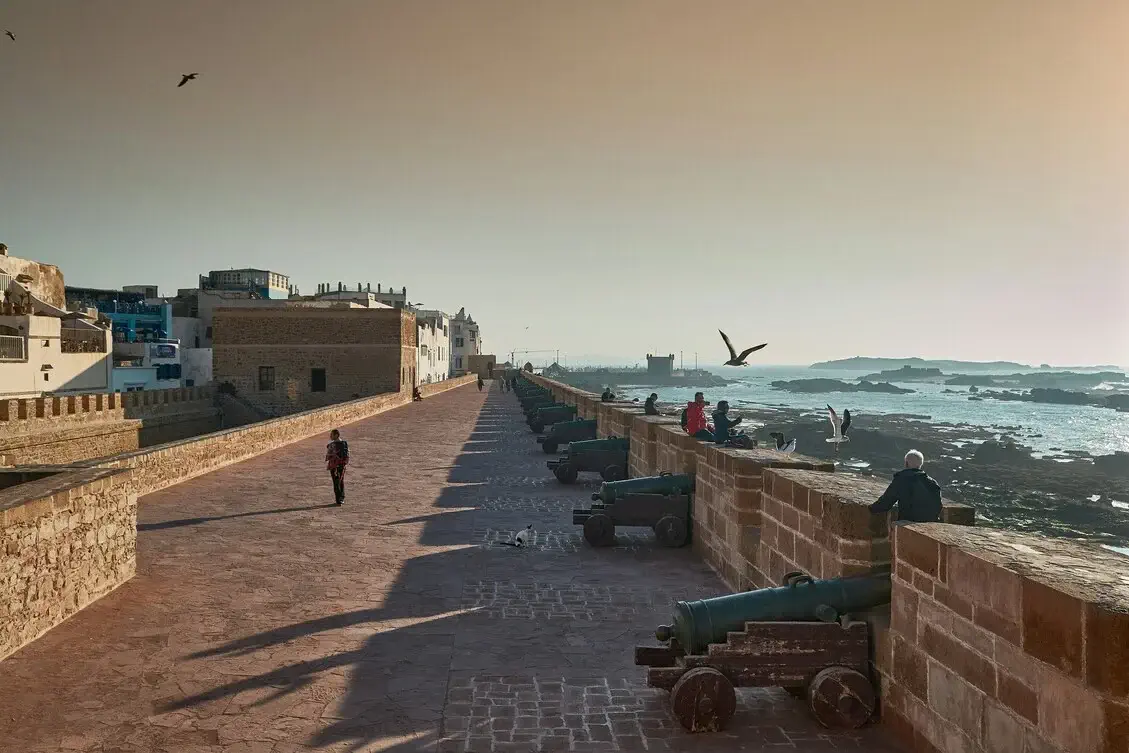
The most iconic experience in this Essaouira travel guide is the Skala de la Ville — the northern sea bastion built by Portuguese architects in the 18th century, lined with ornate bronze cannons pointed out to sea. Walking along the ramparts at sunset, with the Atlantic crashing against the walls below and the medina’s rooftops glowing in the golden light, is one of the most beautiful experiences Morocco offers. The ramparts are free to access and open throughout the day.
2. Explore the UNESCO Medina
The medina of Essaouira is a UNESCO World Heritage Site and one of the most distinctive in Morocco. Unlike the labyrinthine medieval streets of Fes or the frantic energy of Marrakech’s souks, Essaouira’s medina is built on a grid plan, making it one of the easiest medinas to navigate in Morocco.
The medina is the heart of any Essaouira travel guide. The main artery is Avenue Mohammed Zerktouni, lined with jewelry shops, craft galleries, and the workshops of Essaouira’s renowned woodworkers who craft objects from thuya wood — a fragrant local hardwood with beautiful burled grain. Thuya wood boxes, chess sets, and decorative objects are among the finest souvenirs available anywhere in Morocco.
3. Visit the Harbor and Fresh Fish Market
The working fishing port of Essaouira is one of the most active on the Atlantic coast. The morning fish market — where the overnight catch is unloaded, sorted, and auctioned — is a spectacle of noise, color, and barely controlled chaos. By mid-morning, the catch has moved to the harbor-front grill stalls, where you choose your fish and it is grilled on the spot. A generous grilled fish lunch costs 60–120 MAD and should not be missed.
4. Try Windsurfing or Kitesurfing
Essaouira’s consistent Atlantic winds make it one of the world’s finest windsurfing destinations. The long beach south of the medina is lined with surf schools offering lessons for complete beginners at approximately 300–500 MAD for a two-hour introductory session. Experienced riders can rent equipment independently.
5. Moulay Hassan Square at Sunset
The social heart of the city, where cafés spill onto the pavement and the wind carries the smell of grilled fish from the harbor below. Sitting here with a mint tea as the sun sets is pure Essaouira — unhurried, atmospheric, and completely free.
6. Day Trip to Diabat and the Ruins of Dar Soltan
A short walk or taxi ride south of Essaouira, the village of Diabat and the romantic ruins of Dar Soltan — a 19th-century royal summer palace — make for a beautiful half-day excursion. The ruins sit dramatically on a dune overlooking the ocean, and the walk from Essaouira along the beach takes approximately 45 minutes through extraordinary coastal scenery.
7. Shop for Thuya Wood and Argan Products
Essaouira’s craft tradition is entirely distinct from Marrakech’s. Thuya wood objects, handmade jewelry, and locally produced argan oil from the surrounding forest make for some of Morocco’s finest and most authentic souvenirs. The women’s argan oil cooperatives outside the city offer the best quality at the fairest prices.
8. Visit the Gnaoua Music Festival (June)
Every June, Essaouira hosts the Gnaoua World Music Festival — one of the finest music events in Africa, featuring Gnaoua master musicians alongside international jazz and world music artists. The festival transforms the city for four days and draws enormous crowds. Book accommodation months in advance if you plan to attend.
9. Ride a Horse or Camel on the Beach
The long, windswept beach south of the medina is one of the most dramatic stretches of Atlantic coastline in Morocco. Morning conditions are calmer and ideal for horse or camel riding along the sand — operators at the beach offer rides from approximately 100–200 MAD per hour.
10. Explore the Argan Forest
The region around Essaouira is part of a UNESCO-protected argan forest — the only place in the world where the argan tree grows naturally. Half-day excursions into the forest allow you to see the famous goats that climb the argan trees to eat the fruit, and to visit the cooperatives where women hand-press the oil that has made Moroccan argan products famous worldwide.
Where to Eat in Essaouira
The Harbor Grill Stalls: The unmissable Essaouira eating experience and the first food recommendation of this Essaouira travel guide. Choose your fish, watch it grilled, eat it at a plastic table with the harbor smell in the air. Simple, perfect, unforgettable. Budget 60–120 MAD per person.
Chalet de la Plage: One of Essaouira’s most beloved restaurants, occupying a terrace position directly above the beach with views of the ocean. Specializes in fresh fish and seafood. Expect to pay 120–200 MAD for a main course.
Taros Café: A rooftop café-restaurant on the edge of Moulay Hassan square offering excellent views, good Moroccan food, and a relaxed atmosphere that captures the Essaouira spirit perfectly.
Local Restaurants in the Medina: The streets behind the main tourist axis contain dozens of small local restaurants serving harira, tagines, and fresh fish at local prices — 50–80 MAD for a full meal.
Where to Stay in Essaouira
Budget: Hostels and budget guesthouses offer dormitory beds for 80–150 MAD and private rooms for 200–350 MAD per night.
Mid-range Riads: Comfortable riads with private rooms and breakfast typically cost 400–800 MAD per night, often with blue and white color schemes that echo the city’s maritime palette.
Boutique Hotels: Properties like Villa Maroc and Madada Mogador offer beautiful rooms and exceptional service. Expect to pay 1,200–3,000 MAD per night.
How to Get to Essaouira
From Marrakech: CTM and Supratours buses run several times daily (approximately 3 hours, 80–100 MAD). Private transfers cost 600–1,000 MAD per vehicle.
From Agadir: CTM buses run between Agadir and Essaouira (approximately 3 hours, 70–90 MAD).
From Casablanca: CTM operates a direct bus (approximately 6 hours, 130–160 MAD). Alternatively, take the train to Marrakech and connect by bus.
By Car: The drive from Marrakech takes approximately 2.5 hours on well-maintained roads.
Practical Tips for Your Essaouira Travel Guide
- Bring a windproof layer — the Alizé wind is relentless and can make Essaouira feel significantly cooler than the temperature suggests
- Best time to visit: April to June and September to November for the most pleasant conditions
- How long to stay: Two nights minimum, three nights ideal
- Cash: Bring enough dirhams as ATMs can occasionally run low during busy periods
Final Thoughts
This Essaouira travel guide has covered the highlights, but the truth is that the best Essaouira experiences cannot be planned — they happen in the unexpected moments between the sights. The conversation with a woodworker in his thuya workshop. The perfect grilled sardine eaten on a plastic chair at the harbor. The light on the ramparts at the exact moment the sun hits the ocean. Essaouira operates by its own rules — slower, cooler, saltier, and more creative than almost anywhere else in Morocco.
Every Morocco itinerary is better with Essaouira in it. Give it two or three days, let the wind blow away the intensity of the medinas, and you will understand why so many travelers come for a weekend and stay for a month.
For more Morocco city inspiration, read our Chefchaouen travel guide and our 3 Days in Marrakech itinerary. For accommodation booking and official tourism information, visit Visit Morocco.
2 Comments