Meknes Travel Guide (2026) : The Underrated Imperial City You Need to Visit
Meknes is Morocco’s most underrated city. While Marrakech dazzles and Fes overwhelms, while Chefchaouen fills Instagram feeds and Casablanca impresses with its modernity, Meknes quietly goes about its business as one of the finest and least visited imperial cities in North Africa — a place of extraordinary monuments, authentic street life, and almost no tourist pressure.
This Meknes travel guide makes the case for taking Morocco’s fourth imperial city seriously. Not as a day trip from Fes (though it makes an excellent one), not as a transit stop on the way somewhere else, but as a destination in its own right — one that rewards visitors who arrive with curiosity and leave with the feeling that they have discovered something most Morocco travelers miss entirely.
Why Visit Meknes?
Meknes was founded in the 11th century but reached its greatest glory under Sultan Moulay Ismail (1672–1727), who chose it as his capital and spent his 55-year reign transforming it into a city that he intended to rival Versailles. The result — built by tens of thousands of slaves, prisoners of war, and conscripted laborers — was one of the most ambitious building projects in Moroccan history: 25 kilometers of walls, enormous royal stables, vast granaries, a massive palace complex, and the monumental gates that remain Meknes’s most recognizable landmarks today.
Moulay Ismail’s death in 1727 and the subsequent transfer of the capital to Marrakech began Meknes’s long decline from imperial prominence. An earthquake in 1755 destroyed significant portions of the city. The French Protectorate built a new European quarter (Ville Nouvelle) alongside the medina but focused their main attention on Casablanca and Rabat. The result is a city that has been largely bypassed by mass tourism — and that retains, as a consequence, an authenticity and a lack of commercial pressure that makes it one of the most pleasant medinas in Morocco to explore.
The Best Things to Do in Meknes
1. Bab Mansour — The Most Beautiful Gate in Morocco
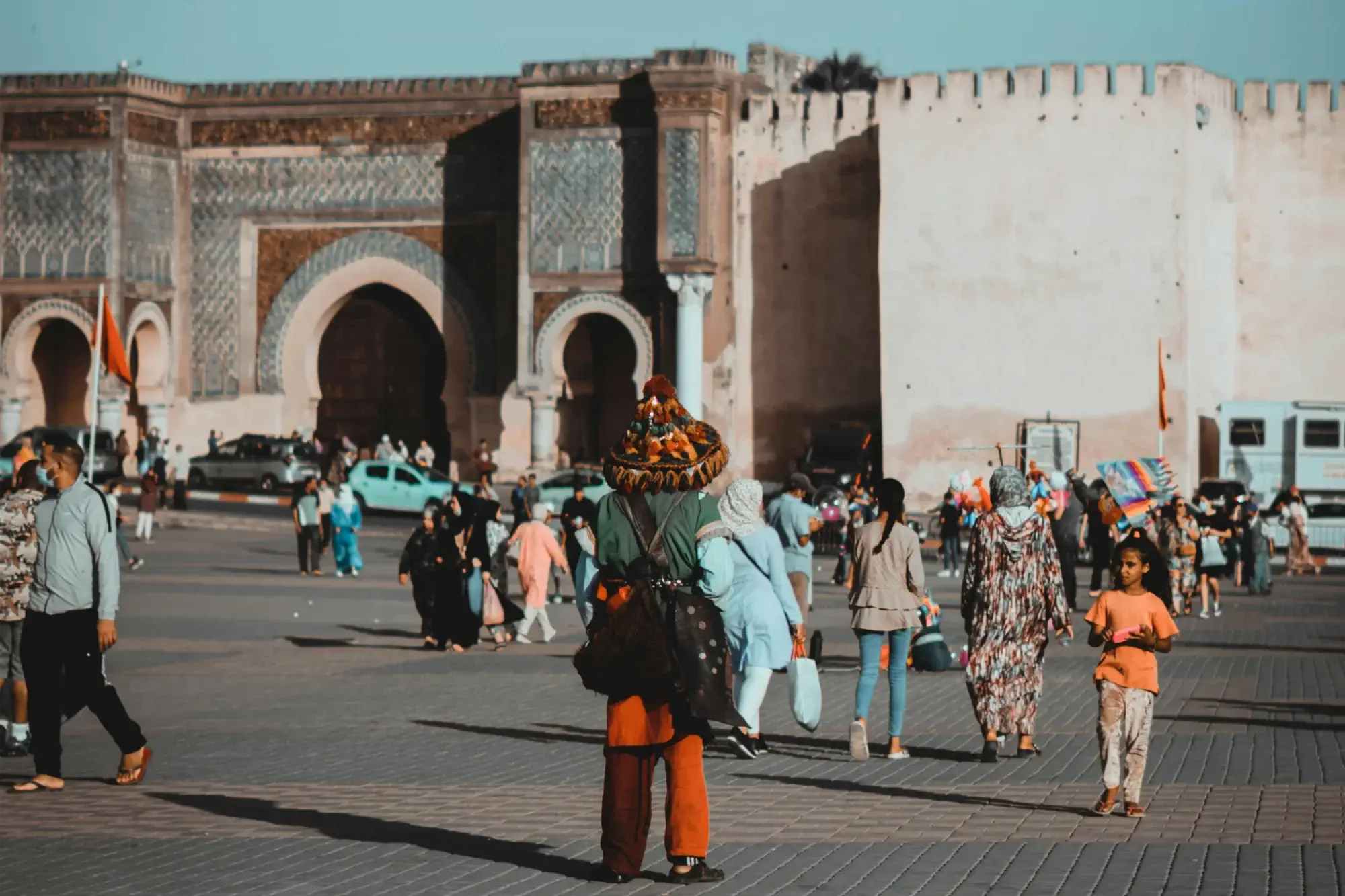
The centerpiece of any Meknes travel guide and one of the most spectacular architectural achievements in the entire country, Bab Mansour is the monumental gateway that formed the main entrance to Sultan Moulay Ismail’s imperial palace complex. Completed in 1732 under Sultan Moulay Abdallah after Moulay Ismail’s death, the gate is named for its architect — a Christian convert to Islam named Mansour — and represents the pinnacle of Moroccan decorative architecture.
The gate’s facade is covered in extraordinarily intricate zellige tilework in green, white, and yellow, framing a massive horseshoe arch decorated with carved stone, Corinthian columns taken from the Roman ruins of Volubilis, and epigraphic panels in Arabic calligraphy. The scale is enormous — the arch alone is large enough to drive a truck through — and the detail is astonishing at every level of examination.
Bab Mansour faces onto Place el-Hedim — Meknes’s main public square, the equivalent of Marrakech’s Djemaa el-Fna but quieter, more local, and entirely authentic. Sit at one of the café terraces facing the gate in the late afternoon light and allow yourself time to simply look at one of the greatest monuments in Morocco.
2. The Mausoleum of Moulay Ismail
Adjacent to Bab Mansour, the Mausoleum of Moulay Ismail is one of the few religious sites in Morocco open to non-Muslim visitors — a privilege that reflects the particular reverence in which the Sultan is held and the significance of the site as a place of pilgrimage. The mausoleum complex contains the tombs of Moulay Ismail and several of his wives and descendants, housed in a series of rooms of extraordinary decorative richness — zellige tilework covering the lower walls, carved plaster above, painted cedarwood ceilings, and a central courtyard with a marble fountain.
Entry is free. Dress modestly and remove shoes at the entrance. Photography is permitted in the courtyard but not in the tomb chamber itself.
3. The Royal Stables and Granaries (Heri es-Souani)
One of the most impressive and most haunting sites in this Meknes travel guide, the Heri es-Souani are the remains of Sultan Moulay Ismail’s legendary royal stables and granaries — a vast complex of vaulted chambers that once housed up to 12,000 horses and the grain supplies to feed both the horses and the garrison of the imperial city.
The scale of the complex is extraordinary — the vaulted chambers stretch for hundreds of meters, their thick earthen walls maintaining a cool temperature even in the Moroccan summer heat. Much of the complex was destroyed by the 1755 earthquake, and the roofless ruins that remain today have a romantic, melancholy quality — a sense of a civilization’s ambition reduced to beautiful rubble. A large artificial lake (Agdal Basin) adjacent to the stables was built to supply the complex with water and today provides a pleasant waterside walk. Entry costs 70 MAD.
4. The Medina and Souks
Meknes’s medina is one of the most authentic and least touristed in Morocco. The main souk area around Rue Souika and the covered market near the Grand Mosque operates primarily for local residents — you will find fabric merchants, spice vendors, butchers, bakers, and craftsmen going about their daily business with minimal reference to the small number of tourists who pass through.
The souk en-Nejjarine (carpenters’ souk) and the souk es-Sebbat (cobblers’ souk) are particularly fine examples of specialized craft markets that have operated continuously for centuries. The Medersa Bou Inania — a 14th-century Quranic school with exceptional carved plaster and zellige decoration — is Meknes’s finest example of Merinid architecture and is worth 45 minutes of careful attention. Entry costs 20 MAD.
5. Day Trip to Volubilis
No Meknes travel guide is complete without the ancient Roman city of Volubilis, located approximately 33 kilometers north of Meknes and representing the finest archaeological site in Morocco. Founded as a Berber settlement and later serving as the westernmost outpost of the Roman Empire, Volubilis reached its greatest extent in the 2nd and 3rd centuries CE before being abandoned following the Roman withdrawal from North Africa.
The ruins are extraordinary — the Triumphal Arch of Caracalla still stands to nearly its full height, the basilica and Capitol complex are remarkably well preserved, and dozens of houses retain their original mosaic floors in extraordinary condition. The mosaics of Volubilis — depicting mythological scenes, hunting episodes, and elaborate geometric patterns — are among the finest examples of Roman mosaic art outside of Italy and North Africa’s coastal cities.
Volubilis was designated a UNESCO World Heritage Site in 1997. Entry costs 70 MAD. The site is best visited in the morning before the midday heat and before the tour groups from Fes arrive.
Getting to Volubilis from Meknes: grand taxis from Meknes’s main taxi stand run to the nearby village of Moulay Idriss (approximately 25 MAD per seat), from where shared taxis or walking covers the remaining 4 kilometers to the site. Alternatively, hire a private taxi from Meknes for approximately 200–300 MAD return including waiting time.
6. Moulay Idriss — Morocco’s Most Sacred City
Two kilometers from Volubilis and easily combined with a visit to the Roman ruins, the hilltop town of Moulay Idriss is Morocco’s most sacred city — the burial place of Moulay Idriss I, the founder of the Idrisid dynasty and the man credited with bringing Islam to Morocco in the late 8th century. Until 1912, non-Muslims were forbidden from spending the night in the town, and it remains a place of deep religious significance.
The town itself is beautiful — white buildings cascading down a dramatic hillside, crowned by the green-tiled roof of the mausoleum at the center. Non-Muslims cannot enter the mausoleum but can explore the surrounding streets and enjoy the extraordinary views from the upper town over the Zerhoun plain toward Volubilis.
The moussem (pilgrimage festival) of Moulay Idriss, held in late August or early September, is one of the largest and most spectacular religious festivals in Morocco — if your Meknes travel guide itinerary coincides with it, attending is an extraordinary experience.
Where to Eat in Meknes
Meknes has a good range of restaurants serving traditional Moroccan food at prices that reflect the local rather than tourist market.
Riad Bahia Restaurant: One of the finest dining experiences in Meknes, serving elaborate traditional Moroccan cuisine in a beautifully restored riad courtyard. The pastilla and the lamb tagine with preserved lemon are particularly good. Expect to pay 150–250 MAD per person.
Restaurant Zitouna: A reliable mid-range option near the medina serving good tagines, couscous, and harira at very reasonable prices — 60–100 MAD for a full meal. Popular with both locals and the small number of tourists who find their way here.
The medina food stalls: The area around Place el-Hedim and the medina entrance has excellent street food stalls serving harira, kefta brochettes, msemen, and fresh orange juice at street prices — 5–40 MAD depending on what you order.
Café de France: The classic colonial-era café on Place el-Hedim offers good coffee, mint tea, and a view of Bab Mansour that is worth the price of any drink on the menu.
Where to Stay in Meknes
Budget: Several small guesthouses and budget hotels in the medina offer rooms for 150–300 MAD per night. The area around Place el-Hedim has the most convenient options for exploring the main sights.
Mid-range: A handful of comfortable riads have opened in Meknes’s medina in recent years, offering private rooms with breakfast for 400–700 MAD per night. Riad Bahia and Riad d’Or are consistently well-reviewed options.
Day trip base: Many travelers experience Meknes as a day trip from Fes — the two cities are only 60 kilometers apart, connected by frequent trains (45 minutes, 25–35 MAD) and grand taxis. If your itinerary is tight, this is a viable approach, though spending at least one night in Meknes allows a more relaxed exploration including the Volubilis and Moulay Idriss excursion.
How to Get to Meknes
By train: Meknes is on the main ONCF rail line between Casablanca and Fes. Direct trains run from Fes (45 minutes, 25–35 MAD), Rabat (approximately 2.5 hours), and Casablanca (approximately 3 hours). Meknes has two train stations — Meknes El Amir Abdelkader (the main station, closer to the medina) and Meknes. For the complete guide to Morocco’s rail network, read our Morocco train travel guide.
By CTM bus: CTM operates regular services from Casablanca, Rabat, Fes, and Marrakech to Meknes. Journey times and prices are comparable to the train.
By car: Meknes is on the A2 motorway connecting Rabat and Fes. For tips on driving in Morocco, read our complete car rental guide.
By grand taxi: Grand taxis run frequently between Fes and Meknes (approximately 25–35 MAD per seat, 1 hour) from Fes’s main grand taxi stand.
Practical Tips for Your Meknes Travel Guide
- How long to stay: One full day covers the main medina sights; two days allows a comfortable Meknes day plus the Volubilis and Moulay Idriss excursion
- Best time to visit: Year-round, though spring and autumn offer the most pleasant temperatures for walking the medina and the Volubilis archaeological site
- Getting around: The medina, Bab Mansour, and the royal stables are all within easy walking distance of each other. Petit taxis cover longer distances cheaply
- Combine with Fes: Meknes and Fes are the natural imperial city pairing — spending two days in Fes and one in Meknes covers both comprehensively. Read our 7 Days in Morocco itinerary for how to incorporate both cities efficiently
Final Thoughts
Meknes will not overwhelm you with its beauty the way Marrakech does, or confound you with its complexity the way Fes does. It will do something quieter and in some ways more rewarding — it will let you experience a Moroccan imperial city at your own pace, without pressure, without the feeling of being managed or marketed at, and with the particular pleasure of discovering something that most travelers simply miss.
Bab Mansour alone is worth the detour. Volubilis alone justifies the visit. The combination of the two, in a city that feels genuinely, unhurriedly itself, makes Meknes one of the finest days available anywhere in Morocco.
For more Morocco city inspiration, read our Fes travel guide, our Rabat travel guide, and our Casablanca travel guide. For official tourism information, visit Visit Morocco.