Rabat Travel Guide: What to See in Morocco’s Elegant Capital City
Rabat is Morocco’s best kept secret. While Marrakech draws the crowds and Fes captures the imagination, Morocco’s royal capital quietly goes about its business as one of the most elegant, livable, and genuinely beautiful cities in North Africa — a city of wide boulevards, immaculate gardens, excellent museums, and a medina that is refreshingly free of the aggressive tourist commerce that characterizes Morocco’s more visited cities.
This Rabat travel guide makes the case for taking Morocco’s capital seriously as a destination in its own right — not just a transit stop between Casablanca and Fes, but a city that deserves at least one full day and ideally two from any Morocco itinerary with the flexibility to include it.
Why Visit Rabat?
Rabat became Morocco’s capital in 1912 under the French Protectorate, chosen for its coastal position and relative distance from the political complexities of Fes and Marrakech. Today, the city is home to Morocco’s royal family, the national government, and the diplomatic community — a combination that has given it a character of cosmopolitan calm that is entirely distinct from any other Moroccan city.
The absence of mass tourism is Rabat’s most immediately noticeable quality for visitors arriving from Marrakech or Fes. In the medina, shopkeepers do not call out to passersby. In the cafés, tourists are a minority rather than the dominant presence. The city operates for its own residents rather than for visitors, and engaging with it on that basis produces one of the most authentic urban experiences in Morocco.
The 10 Best Things to Do in Rabat
1. The Hassan Tower and Mohammed V Mausoleum
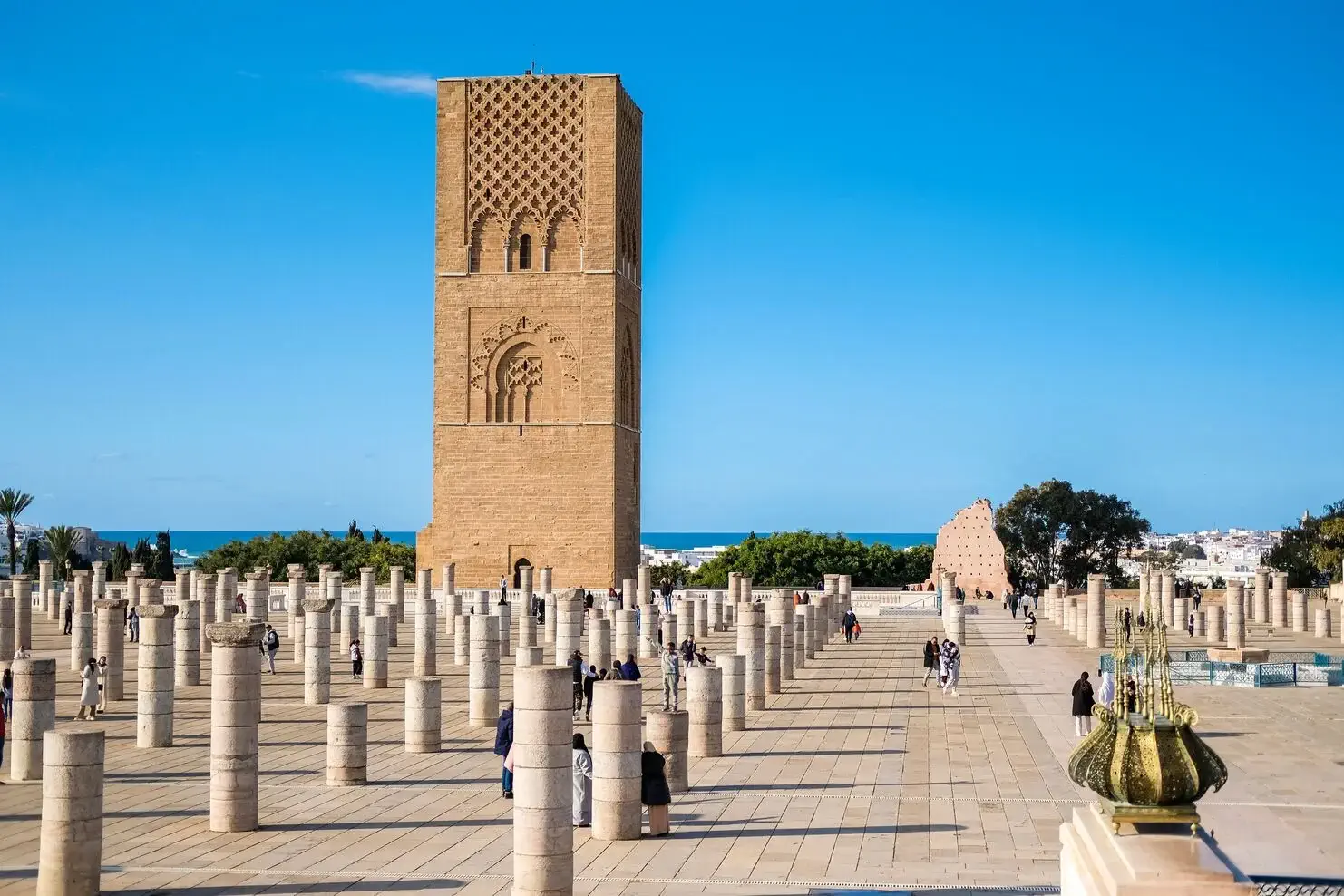
The most iconic sight in any Rabat travel guide is the Hassan Tower — a 44-meter minaret begun in 1195 by the Almohad Sultan Yacoub al-Mansour as part of what would have been the largest mosque in the world. Construction was abandoned after the sultan’s death in 1199, leaving only the minaret and the forest of 200 columns that were to have supported the mosque’s roof — one of the most hauntingly beautiful architectural ruins in Morocco.
Adjacent to the Hassan Tower, the Mohammed V Mausoleum houses the tombs of King Mohammed V (the founder of modern Morocco who led the country to independence in 1956) and his two sons. The mausoleum is one of the finest examples of contemporary Moroccan craftsmanship — opened in 1971, it represents a tour de force of traditional techniques: carved plaster, painted cedarwood ceilings, zellige tilework, and hand-carved marble. Unusually for a religious site in Morocco, it is open to non-Muslim visitors. Entry is free.
The combination of the tower ruins and the mausoleum, set on a esplanade above the Bou Regreg river, makes this the most visually dramatic hour of any Rabat travel guide.
2. The Kasbah of the Oudayas
The Kasbah of the Oudayas occupies the headland above the point where the Bou Regreg river meets the Atlantic Ocean — one of the most beautiful locations in Morocco. Founded in the 12th century as a fortified position commanding the river mouth, the Kasbah is today a residential neighborhood of blue and white painted houses, narrow alleys, and extraordinary views.
The main entrance is through the magnificent Almohad gate — one of the finest examples of Moroccan monumental architecture, its horseshoe arch decorated with carved stone in geometric and floral patterns that retain their extraordinary detail after eight centuries.
Inside the Kasbah, the Andalusian Garden (free entry) is one of the most peaceful spaces in any Moroccan city — a formal garden of orange trees, roses, and flowering hedges laid out in the style of the Andalusian gardens that Moorish refugees brought to Morocco after the fall of Granada in 1492.
The café terrace at the edge of the Kasbah, overlooking the ocean and the Salé coastline across the river, is one of the finest spots in this Rabat travel guide for a mint tea and a moment of absolute calm.
3. The Medina of Rabat
Rabat’s medina is one of the most pleasant in Morocco for the simple reason that it has not been heavily touristed. The commercial pressure, the fake guides, and the commission-based shop introductions that characterize Marrakech’s souks are largely absent here — you can walk through the medina’s markets at your own pace, browse without obligation, and engage with vendors on equal terms.
The main commercial street, Rue Souika, runs through the heart of the medina and is lined with fabric shops, spice vendors, jewelers, and the everyday commerce of a living Moroccan neighborhood. The covered section near the central mosque contains some excellent traditional craft shops selling quality Moroccan ceramics, leather goods, and textiles at prices that are notably more reasonable than their equivalents in Marrakech.
The medina walls — particularly the section along Avenue Hassan II — date from the 17th century and are among the best preserved in Morocco.
4. The Chellah Necropolis
One of the most extraordinary and least visited sights in this Rabat travel guide, the Chellah is a walled medieval necropolis built on the ruins of the Roman city of Sala Colonia on the southern edge of Rabat. Constructed in the 14th century as a royal burial complex by the Merinid sultans, the Chellah today is a romantic ruin of collapsed minarets, ancient tombs, and overgrown gardens inhabited by storks and cats.
The combination of Roman ruins, medieval Islamic architecture, and wild nature produces one of the most atmospheric sites in Morocco. Entry costs 70 MAD and the site deserves at least an hour. The storks nesting on the ruined minaret are a particular draw — they have been a feature of the Chellah for centuries.
5. Mohammed VI Museum of Modern and Contemporary Art
Opened in 2014, the Mohammed VI Museum of Modern and Contemporary Art is the finest art museum in Morocco and one of the best in Africa. The permanent collection focuses on Moroccan modern and contemporary art — painters, sculptors, and installation artists who have defined Moroccan visual culture since independence — and is presented in a purpose-built contemporary building of considerable architectural quality.
Temporary exhibitions of international quality rotate regularly. Entry costs approximately 60 MAD and the museum is worth two to three hours of careful attention. The museum café is one of the better lunch options in the immediate vicinity.
6. The Royal Palace (Dar al-Makhzen)
The Royal Palace of Rabat is not open to visitors — it is the working residence of King Mohammed VI and his family — but the approach along Avenue Mohammed V and the view of the palace gates from the adjacent square are worth including in any Rabat travel guide. The golden gates, the immaculately uniformed guards, and the scale of the palace walls give a vivid impression of the institution of Moroccan monarchy that defines the country’s political culture.
7. The Bou Regreg Riverfront and New City
The ongoing development of Rabat’s Bou Regreg riverfront — a massive urban regeneration project that has transformed the area between the medina and the river — has produced one of the most pleasant waterfront promenades in Morocco, with cafés, restaurants, and a marina that brings a Mediterranean quality to the city’s character. Walking the riverfront from the Kasbah of the Oudayas south to the new marina is one of the most enjoyable walks in this Rabat travel guide.
8. The Agdal Garden
The Agdal Garden — a historic royal garden on the southern edge of the medina — is one of Rabat’s most overlooked pleasures. Open to the public on certain days (check locally for current access), the garden dates from the 12th century and covers several hectares of orange, olive, and fruit trees irrigated by a traditional hydraulic system. When open, it provides an extraordinary escape from the city within the city.
9. The National Museum of Archaeology
Housed in a colonial-era building near the medina, the National Museum of Archaeology contains one of the finest collections of Moroccan antiquities in the country — Neolithic artifacts, Phoenician objects, Roman sculpture and mosaics from Volubilis, and medieval Islamic decorative arts. Entry is inexpensive and the collection is genuinely illuminating for visitors interested in the deep history behind the Morocco they are experiencing.
10. Salé — Rabat’s Twin City
Across the Bou Regreg river from Rabat sits Salé — historically a separate city and former pirate stronghold, now effectively part of the Rabat urban area. The Salé medina is smaller and less visited than Rabat’s, but its Friday souk is one of the most authentic traditional markets in northern Morocco, and the view of Rabat’s Kasbah from the Salé waterfront is one of the finest perspectives on the city.
A ferry crosses the river between the two cities for a few dirhams — one of the most pleasant and most underused experiences in this Rabat travel guide.
Where to Eat in Rabat
Rabat’s restaurant scene is less celebrated than Marrakech’s but offers some of the most honest and best-value Moroccan and international food in the country.
Le Dhow: A restaurant and bar on a boat moored in the Bou Regreg marina, serving Moroccan and international food with extraordinary views of the Kasbah of the Oudayas across the water. One of the most atmospheric dining experiences in Rabat. Expect to pay 150–250 MAD per person.
Dinarjat: A beautifully restored traditional Moroccan house near the medina serving excellent formal Moroccan cuisine. The pastilla and the mechoui are particularly good. Expect to pay 200–350 MAD per person.
Café Maure: Located within the Kasbah of the Oudayas, the Café Maure serves mint tea, Moroccan pastries, and light food on a terrace overlooking the Andalusian Garden and the ocean. One of the finest café experiences in any Rabat travel guide. Prices are very reasonable — 20–50 MAD for tea and pastries.
The Medina food stalls: The food stalls and small local restaurants along Rue Souika and the medina side streets serve excellent, inexpensive Moroccan food — harira, tagines, sandwiches — at local rather than tourist prices.
Where to Stay in Rabat
Budget: Several well-reviewed budget guesthouses and small hotels in and around the medina offer private rooms for 200–400 MAD per night. The medina is the most atmospheric area to stay.
Mid-range: A number of comfortable boutique hotels and small riads operate in Rabat’s medina and the adjacent Hassan neighborhood, typically 400–800 MAD per night.
Luxury: The Sofitel Rabat Jardin des Roses and the Hyatt Regency Casablanca-Rabat represent the international luxury end of the market, with rates from 1,500 MAD per night.
How to Get to Rabat
By train: Rabat is exceptionally well connected by ONCF train. Direct trains run from Casablanca (approximately 1 hour, 55–70 MAD), Fes (approximately 3 hours, 100–130 MAD), and Tangier via the Al Boraq high-speed service (approximately 1.5 hours). Rabat Ville station is in the heart of the city — no taxi required to reach the medina or major hotels. For the complete guide to Morocco’s rail network, read our Morocco train travel guide.
By car: Rabat is on the main motorway linking Casablanca (90 kilometers, approximately 1 hour) with Tangier (350 kilometers, approximately 3 hours).
Practical Tips for Your Rabat Travel Guide
- Time needed: One full day covers the essential sights of this Rabat travel guide comfortably; two days allows a relaxed pace plus Salé and the Chellah
- Best time to visit: Year-round — Rabat’s Atlantic coast location keeps temperatures moderate even in summer
- Getting around: Rabat is a walkable city — the medina, Hassan Tower, and Kasbah of the Oudayas are all within 20 minutes on foot of each other. Petit taxis (blue) cover longer distances cheaply
- Safety: Rabat is consistently rated the safest major city in Morocco — the tourist scam culture that exists in Marrakech and Fes is largely absent here
Final Thoughts
Rabat does not shout. It does not perform Morocco for the tourist gaze or deploy the full machinery of medina commerce on every street corner. It simply exists — elegant, calm, and thoroughly itself — and rewards the visitor who takes the time to engage with it on its own terms.
In the context of a Morocco itinerary that includes Marrakech, Fes, and the Sahara, Rabat is the breath of fresh air — the day you remember not for any single spectacular sight but for the quality of its light, the mint tea at the Café Maure, and the extraordinary view from the Kasbah of the Oudayas at sunset.
For more Morocco city inspiration, read our Casablanca travel guide and our Chefchaouen travel guide. For transport planning, read our Morocco train travel guide. For official tourism information, visit Visit Morocco.