
Morocco Taxi Guide: 5 Essential Things Every Traveler Must Know
Understanding how the Morocco taxi system works is the single most useful practical skill you can develop before your trip. Whether you are navigating the narrow streets around a medina, crossing a city to reach a train station, or traveling between towns on routes not served by buses, understanding how Morocco’s taxi system works is one of the most practical skills a visitor can develop. Get it right and you will move around the country cheaply and efficiently. Get it wrong and you will overpay consistently and arrive frustrated.
This Morocco taxi guide covers everything you need to know — the two main types of taxi, how they operate, what they cost, how to negotiate, and how to avoid the most common problems visitors encounter.
The Two Types of Morocco Taxi
Morocco has two distinct taxi systems that serve different purposes and operate according to different rules. Understanding the difference is the foundation of this Morocco taxi guide.
Petit Taxi: City Transport
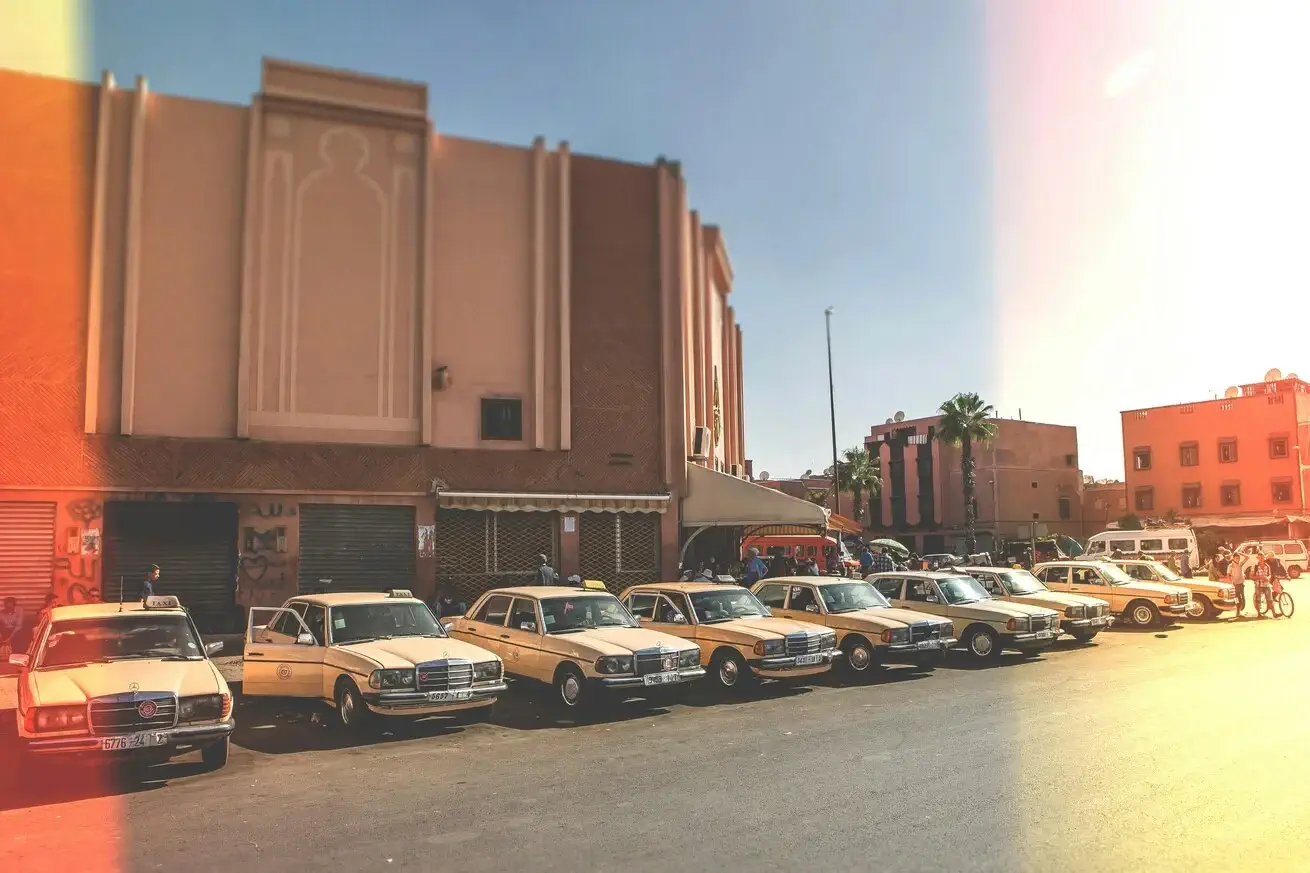
The Morocco taxi color system makes identification simple once you know it. They are typically compact cars — Dacia Logans, Peugeot 207s, and similar economy vehicles are common — and are easily identified by their distinctive solid color, which varies by city:
- Marrakech: Beige/cream colored petit taxis
- Casablanca: Red petit taxis
- Fes: Red petit taxis (a different shade from Casablanca)
- Rabat: Blue petit taxis
- Chefchaouen: Blue petit taxis
- Tangier: Blue petit taxis
- Essaouira: Blue petit taxis
The color coding makes Morocco taxi identification straightforward in most cities — the small, solid-colored car waiting outside your riad or at the corner is almost certainly a petit taxi.
How petit taxis work: Petit taxis can carry a maximum of three passengers and are licensed to operate only within their designated city. They may stop to pick up additional passengers going in the same direction — this is completely normal and not something to object to, as the fare is calculated independently for each set of passengers.
Petit taxi fares: All petit taxis are supposed to operate with a meter (compteur), though in practice many drivers — particularly in tourist-heavy areas — will attempt to negotiate a flat fare instead. The metered fare is almost always cheaper than the negotiated flat fare for tourists. Always ask for the meter: “Compteur, s’il vous plaît” (French) or “B’compteur” (Darija).
Typical metered fares within cities range from 15–40 MAD for most journeys. Night fares (typically after 8 PM) carry a surcharge of approximately 50 percent.
Grand Taxi: Inter-City Transport
Morocco taxi grand taxis are the lifeline of inter-city transport on routes not covered by trains or buses., often W123 or W124 models with hundreds of thousands of kilometers on the odometer — that operate between towns and cities on fixed routes.
Unlike petit taxis, grand taxis are not city vehicles. They depart from designated grand taxi stands (usually located near bus stations or at the edge of town) and travel fixed routes between specific destinations. They depart when full — typically when six passengers are seated (two in front, four in the back) — rather than on a fixed schedule.
Grand taxi fares: Grand taxis charge a fixed price per seat for each route, typically 20–40 percent cheaper than the equivalent CTM bus fare. The price is standardized for each route — ask locals or at your accommodation what the correct price is before approaching the taxi stand, so you know what to pay.
You can also hire a grand taxi privately (paying for all six seats) if you want to travel without waiting for other passengers or if you need to go to a destination that is not on a standard route. Private grand taxi hire costs approximately four to five times the per-seat price.
How to Use a Petit Taxi in Morocco
Hailing a Petit Taxi
Petit taxis can be hailed directly from the street in most Moroccan cities. Simply stand at the roadside, make eye contact with approaching taxis, and raise your hand. Taxis that are available will slow down — those that do not are either occupied or going in a different direction.
In busy medina areas where cars cannot enter, petit taxis wait at designated stands near the major gates (babs). In Marrakech, for example, taxis wait near Bab Doukkala and Djemaa el-Fna; in Fes, near Bab Bou Jeloud.
Always Insist on the Meter
This is the most important practical advice in this Morocco taxi guide. When you get into a petit taxi, immediately say “compteur, s’il vous plaît” (use the meter, please). If the driver says the meter is broken, that it does not work in this area, or that a flat rate is better, these are almost always pretexts to charge tourist prices.
If a driver refuses to use the meter and you cannot agree on a fair flat rate that corresponds to the metered equivalent, get out and find another taxi. In busy areas, another taxi will appear within minutes.
Agreeing on a Flat Rate
In some situations — particularly late at night, in less busy areas, or when traveling with luggage — negotiating a flat rate may be more practical than insisting on the meter. If you know the approximate metered price for your journey (ask at your riad or hotel), negotiate from that figure. A reasonable flat rate for a tourist should be only marginally above the metered equivalent.
Night Taxis and Shared Rides
After approximately 8 PM in most cities, petit taxis apply a night surcharge — typically 50 percent above the metered daytime rate. This is legitimate and should be factored into your expectations.
As noted above, petit taxi drivers may stop to pick up additional passengers going in the same direction. This is completely standard practice and is not cause for concern. Each set of passengers pays their own fare independently.
How to Use a Grand Taxi in Morocco
Finding the Grand Taxi Stand
Every Moroccan town has a grand taxi stand (place des grands taxis), usually located near the central bus station or at one of the main city gates. In some cities, different stands serve different destinations — Marrakech has separate grand taxi stands for different directions (toward Casablanca, toward Agadir, toward the Atlas Mountains).
Ask at your accommodation which stand serves your destination and how to reach it — a petit taxi to the grand taxi stand is often the easiest starting point.
Understanding the Departure System
Grand taxis depart when they have a full complement of passengers — typically six. If you arrive at the stand and find a taxi going to your destination, you join the queue of waiting passengers and pay per-seat price when the taxi departs. During busy periods (Friday mornings, Sunday evenings), taxis fill quickly. During quiet periods, you may wait 30–60 minutes for a taxi to fill.
If you do not want to wait, you can pay for one or more additional seats to fill the taxi and depart immediately. Paying for two seats (your own plus one extra) gives you more space and control over departure time; paying for all remaining seats gives you a private taxi.
Grand Taxi Routes and Connections
Grand taxis typically operate on short to medium routes — between neighboring towns and cities — rather than the full length of Morocco. Longer journeys require multiple connections. For example, traveling from Marrakech to Chefchaouen by grand taxi would require connections through Casablanca, Rabat, and other points, making CTM buses or trains a significantly more practical option for longer distances.
Grand taxis excel for routes of 30–150 kilometers where bus frequencies are low or no train service exists — connections between small towns in the Atlas Mountains, between medinas and their airport cities, or between tourist destinations that are close but not linked by direct public transport.
Common Morocco Taxi Problems and How to Avoid Them
Overcharging Tourists
The most common issue visitors encounter with Morocco taxi is being charged far above the fair rate, particularly from airport taxi stands and outside major tourist attractions.
The solution is straightforward: know the approximate correct price before you get in (ask at your hotel), insist on the meter wherever possible, and be prepared to negotiate firmly or walk away if the quoted price is unreasonable. A 10–20 percent premium above the metered rate for the convenience of an immediate taxi is reasonable; paying three or four times the correct fare is not.
Airport Taxis
Airport taxi drivers in Morocco — particularly at Marrakech Menara Airport — are known for charging significantly above standard rates. The official licensed taxis from Marrakech airport charge a fixed rate of approximately 100–150 MAD to the medina, which is higher than the normal metered rate but is the official airport taxi fare. Agreeing on this before getting in avoids disputes on arrival.
Ride-hailing apps (see below) can sometimes be used from airports and offer more transparent pricing.
Fake Taxis
In tourist-heavy areas, unlicensed vehicles sometimes pose as taxis. Legitimate Morocco taxi vehicles display the taxi type prominently, have a license plate that includes the word “taxi,” and — for petit taxis — display the city’s taxi color. Avoid unmarked vehicles offering transport, particularly near airports and major tourist sites.
The “My Friend Has a Shop” Detour
Some petit taxi drivers in heavily touristed areas attempt to take passengers on unsolicited detours to shops, carpet dealers, or “friend’s” businesses, earning a commission for the visit. If your driver is taking an unusual route, ask directly: “Djemaa el-Fna direct, s’il vous plaît” (or your destination direct). Most will comply immediately when asked clearly.
Ride-Hailing Apps in Morocco
Careem (owned by Uber) operates in Casablanca, Rabat, and Marrakech, offering an alternative to street hailing for Morocco taxi with upfront pricing and a digital payment option. Heetch is a newer alternative operating in Morocco’s major cities.
These apps offer the significant advantage of price transparency — you see the fare before confirming the journey — and eliminate the need to negotiate or insist on the meter. The prices are typically slightly above metered petit taxi rates but below the inflated tourist flat rates often quoted on the street.
For visitors who find the negotiation aspect of Morocco taxi culture stressful, these apps are an excellent alternative, particularly for airport transfers and late-night journeys.
Morocco Taxi Prices: Practical Reference
Petit taxi within city (metered): 15–40 MAD for most journeys
Petit taxi at night (after 8 PM): metered rate + 50% surcharge
Airport petit taxi (Marrakech to medina): 100–150 MAD fixed
Grand taxi per seat (typical short route, 20–50 km): 15–40 MAD
Grand taxi private hire (full vehicle): 4–5 times per-seat price
Careem/Heetch: slightly above metered petit taxi rates, displayed upfront
Final Thoughts
Morocco’s taxi system is genuinely excellent value and, once you understand how it works, one of the most convenient ways to get around in the country. The petit taxi network covers every corner of every city; the grand taxi system connects towns and cities that trains and buses do not reach. Together they form a transport layer that, with a little knowledge and confidence, puts the whole country within easy reach.
The key is entering every Morocco taxi interaction with realistic expectations, a sense of the correct price, and the confidence to negotiate or walk away when the situation calls for it. You will not always get the metered rate, but you will get a fair one — and that is usually enough.
For more Morocco transport planning, read our complete Morocco train travel guide and our Marrakech to Fes transport guide. For current taxi regulations, visit Visit Morocco.

4 Comments